Saturday, December 10, 2022

[Feature] The Whale (2022) - Or a reflection on my own journey from the Brink of Death


What does it mean to be human? That's a loaded question for which there are numerous answers. For myself, the answer has always been the ability to show empathy, love and compassion for one another. But sometimes we are also guilty of neglecting our own well-being in pursuit of putting others before ourselves. Being human means we will make many mistakes along the way. Hopefully we will also learn from those mistakes. But what does it mean to be human when you're trapped in a 600 pound shell?


Recently, I had a chance to check out an early screening of The Whale. The new film by Darren Aronofsky, starring Brendan Fraser. As someone who has battled with weight issues and morbid obesity for practically his entire life, I was very intrigued by this film. I also happen to be a fan of both Aronofsky and Brendan Fraser.


There has been much talk about this film regarding the comeback performance of Fraser and all I can say is believe the hype. Brendan Fraser delivers an outstanding performance in this film. That goes without saying.


His depiction of the near 600 pound recluse Charlie is both a triumph of physical and emotional being. You feel the weight and burden both physically and mentally as Fraser disappears into the character. But more than that, his kindness and ability to find the good in others radiates the most.


I’m not going to lie. The film doesn’t pull punches in reminding us of Charlie’s hazardous physical being. His wheezing for air as his lungs collapse under his mass weight is audible throughout. You can feel the physical pain of his joints underneath. Those around him who do care for him don’t pull punches in their comments. Their words, at times, can be scathing but do not always come from a place of hate, but rather a place of distress.


It is a film that doesn’t pull punches as to just how life-threatening his condition is. Charlie is at the point of no return. He’s on his deathbed and those around him are left to watch as he deteriorates.
At first, this was admittedly frustrating for me. Seeing where I am now as I fight to change my life, I felt a strong desire to slap, hug and plead for this character to get help. But as I continued with the film, I started to put myself back into the mindset that I was under a year ago in order to better empathize with him.


At my heaviest, I weighed 225kg. Last year, I developed an ulcer on my leg due to both my weight and reduced circulation thanks to untreated swelling from a lower back operation. I had to undergo home nursing for about 6 months as they attended to my leg twice a week, applying compression therapy in order to heal the wound.


At the height of my depression, I was reduced to a mere shell of my former self. I had no will to fight. I was overeating like crazy. I was ordering from McDonalds almost every day through Uber Eats. I was eating up to 20 McNuggets per day. I was drinking close to 5 cans of Coke a day. My health was deteriorating like crazy. The most I would move in a day was from my bedroom to my PC, where I would sit for hours on end as the weight grew and grew. For all intents and purposes, I was ready to die last year.


My nurses would get frustrated with me to no end. They would try to motivate me to make a change. They would try to get me to walk down to the end of the street and back. Some days I would try. On those days, I was huffing and puffing half way down the street as my leg muscles were in pain from the lack of use. Most days I was kind to the nurses. They would tell me that I was a kind and sweet person in return.


But anytime the conversations got real, I would ultimately shut down and put up the wall as my own self-loathing came to the forefront. Anytime they tried to motivate me, I would enter full defeatist mode. They would try to encourage me to go out and walk. And I would fight them at every turn, telling them “it was all pointless.” I had no hope in my life and was truly ready for it to end, thinking that I had become a worthless burden to society. All of this eventually led to me attempting to take my own life.


Last year was the lowest point of my life. It got to where I was reaching the point of no return. I didn’t quite reach the level that Charlie did. I never quite reached the 500 pound mark, let alone over 600 pounds, but I dare say I was on my way to that point.


Today, I am not the same person I was a year ago. I've been making steady changes in my life for the better and I have lost some weight in the process. I have been fighting to make a change in my life. As I was watching the film, it slowly dawned on me that my frustration with this character was really the mirror reflecting right back at me showing me who I once was. 


Charlie is a man of great compassion. He is entirely selfless to a fault. He will put everyone before his own well-being. Here is a broken man who is suffering from chronic depression as he never dealt with the untimely death of his lover. Instead of facing his demons, he became addicted to binge eating in order to ease the pain. He is always apologizing for being a burden. He has a tendency to call himself “awful.”


He hides his existence from the world in his one bedroom apartment. His one friend - a home attending nurse - loves him to death but is left frustrated by his inability to fight the demons in his own head. Meanwhile, his teenage daughter is entirely spiteful towards him. She runs a hate blog dedicated to mocking her own mother amongst others in her life.


But she is not entirely without a reason for doing so, as she is the product of a broken home. Her father does indeed love her, but the family unit she once knew as a child was torn apart after Charlie came out of the closet and left his former home. She’s just as lonely and broken as he is and hatred is simply her outlet. And yet, despite her mean-spirited nature, Charlie still sees the good in her even when most others cannot. Charlie is a man who can see the good and beauty in others even if they can’t see it in themselves. But unfortunately, he will not allow himself that same sense of compassion and forgiveness.


The film is simply a tale of a man attempting to find some measure of redemption. In some ways, Charlie’s weight is actually the least important thing to Charlie himself. Even if that lack of concern is hazardous to the character's health, it goes to show that what is truly eating at him is his despair. Much like every film that Aronofsky has made, the film is just as concerned with Charlie’s mental well being as it is his physical being. 


The two factors are entirely linked and, as I have discovered in my own journey thus far, if the two aren’t in balance, then it’s a recipe for disaster. You simply can’t have a healthy body without a healthy presence of mind. The film doesn’t shy away from outwardly expressing this.


Addiction is a common theme in all of Aronofsky’s work and here is no different. His films have always dared to delve deeply into the human psyche. He is fearless in his willingness to explore the hearts and minds of the traumatized. In doing so, he is asking the audience to look more deeply into themselves to find the meaning.


Because of this, there has been some discourse online as to whether the film is “toxic” or “fat-phobic.” I personally don’t see it that way. I think such claims made by the fat acceptance movement are just absurd and are way too focused on the exterior without giving the film an inch of critical thought. One of the reviews I read stood out to me and I quote: “It reinforces the notion that fat people have brought their own suffering upon themselves through lack of coping skills.” Actually, this quote annoyed me to no end.


While I don’t speak for every overweight person out there, I will say that my weight issues have always stemmed from childhood trauma which resulted in an inability to cope with my own lack of self-worth. Ever since I was a kid, I have never had much in the way of self-worth and have always thought of myself as being a worthless burden that had nothing to offer. It was a cold, harsh truth I had to face in my own time. As too have many others who have shared a similar journey.


Again, I can only speak for myself, but to deny my personal experiences isn’t a means of coming to my aid and protecting me. Rather, it’s an ugly form of patronizing. That to me is more “fat-phobic” than anything I saw in this film as it denies anything I may have to say on the matter at hand. Let me speak for myself instead of trying to protect my feelings or explain away my situation in life. If anything, the film is far more compassionate to those facing such hardships than it is phobic.


The link between mental and physical health has indeed been proven time and time again and it shouldn’t be denied or ignored just because it potentially hurts feelings. If anything, that’s all the more of a reason to talk openly about these issues in order to remove the stigma around mental health. 

In a way, I see this film as a companion piece to The Wrestler. Another film by Aronofsky that also explores a fractured father-daughter relationship driven to collapse due to the father not being able to find balance in his own life. The common thread between both films is the need for balance and how balance is key in life. As someone important to me said recently: "The gut is like the second brain. Take care of it just as much as you would the brain."


As the final credits rolled and the tears stained my eyes, I further reflected on both the film and my own journey so far and as to why this film felt like a reflection.


I was once in that same position as Charlie. I was able to see the beauty in others but could not see that same beauty in myself due to my self-loathing. I was unable to give myself a break when I failed. I was unable to show myself compassion when others could. I was selfless to a fault as I would put others before my own well being. Much like Charlie, I too was hanging onto the demons of my past and letting that heartache define me.Charlie isn’t just dying of deteriorating physical health, he is dying due to his inability to deal with his own emotional heartache. 


But in the end, he does attempt to reconcile with his daughter. He does attempt to make something of a small change. Further reminding us that it’s never too late to make a change. It’s never too late to reach out. It’s never too late to find a sense of self-compassion. And that takes real strength of character to do.


Even when you are at the end of your rope physically, you can still attempt to make a change and find some measure of inner peace. Unlike Aronofsky’s other films, this isn’t just a film about watching a character's unhealthy obsessions lead to self-destruction; rather it’s a film about someone trying to find a measure of inner peace and reconciliation.


If you can look past the 600 pound exterior and gaze into Fraser’s eyes, you will find a fragile, frail and lonely human being yearning for connection. Instead of focusing on the exterior, try looking into the eyes of another to see the window to their humanity. You might find something much more and you never know what showing kindness might do for someone who is in great pain. And that will always mean more than anything in the long run.


The Whale is a film that is entirely human in nature. Flawed, ugly-at-times, frustrating, painful, sad, fragile, amusing-at-times and shabby. But also beautiful and compassionate at heart. Like the greatest artworks; it’s a story that finds what it is to be human…even if you are trapped in a 600 pound shell.


-Daniel M

Friday, December 9, 2022

[Review] - Violent Night (2022)


Take a cup of Die Hard, a tablespoon of Home Alone, a little drop of Bad Santa and even just a dash of the 1994 comedy Greedy; pour all of these into a script writing blender, turn it to max and what do you get? You get Violent Night. With a list of ingredients this good, you might expect a new Christmas classic in the making. Unfortunately though, that’s not entirely the case here, as a fun premise is ultimately let down by a lacking screenplay.

The film follows Jolly Saint Nick (David Harbour) as he goes about his Christmas Eve duties. However, he’s anything but jolly rather he’s a jaded, embittered drunk who has just about had enough of the job. As he sits at a bar sinking his misery with a cold one, he laments that the magic is entirely gone from Christmas. Replaced by consumerism as everyone just wants more and more without truly appreciating what they have. 


Meanwhile, on the other side of town, a wealthy family is enjoying the misery of one another's company. That is until a team of elite mercenaries, led by a Christmas-hating mastermind who goes by the codename Scrooge (John Leguizamo), invade the estate looking to steal a hefty 300 million dollars located in a massive vault on the premises.

Little do they know that Santa also just happens to have arrived on the premises. Unfortunately for Santa, he finds himself stuck unwillingly in the night from hell as his reindeer flee in fear. Armed with only his bare fists, Santa transforms into John McClane as he takes on the team of mercenaries in a bloody game of cat and mouse.

On paper, there is a lot going for Violent Night that, in the right hands, could have been elevated into a true Christmas classic. But as it is, it kind of just labors in the middle of the road. David Harbour does well enough to carry the film on his back as the completely jaded and worn out Santa, but he is let down by a screenplay that never quite elevates into anything truly remarkable.

At the beginning of the film, we see a montage of Santa going from house to house in his drunken stooper, growing increasingly frustrated by the lack of Christmas spirit as an overabundance of Amazon packages claim real estate under each Christmas tree. One can’t help but be reminded of Billy Bob Thornton’s Bad Santa in these opening scenes and one could be fooled into thinking it might deliver something close to that jaded masterpiece. But sadly, that’s about as far as the film ever goes with the satire.

As he roams the estate silently taking on the mercenaries, he finds himself earning the trust of the plucky young Trudy (Leah Brady), who is still young enough to believe in Santa. The two bond as the night goes on, leading the film to find a gushy heart instead of going all the way with the initial jaded premise. 


Even Bad Santa, with its alcohol and vomit-stained jadedness, still managed to find a delicate balance between obscenely crude and raw beating heart. Sadly, Violent Night opts for one over the other, with somewhat disappointing results. Leah Brady and David Harbour play well off one another, but it just never elevates to anything truly remarkable or noteworthy. It just feels like it’s going through the motions. It never dares to take any real risks with the material opting to play it incredibly safe all around. For a film that wants to have a razor sharp edge, it’s remarkably toothless.

From the offset, the film establishes the wealthy family as a bunch of kiss ass snobs. They could almost be cut from the same loins as the McTeague family of the 1994 comedy Greedy. They kiss the ass of the wealthy Matriarch (Beverly D’Angelo) in the hope that she will impart the family fortune to one of them. Now that sounds like a deviously fun setup for which a better screenplay could have had some fun with. But sadly, the screenplay does absolutely nothing with any of this giving everyone nothing to do but to sit around and wait as Santa kills the bad guys. 


John Leguizamo has fun hamming it up as the leader of the mercenaries. But he, too, isn’t given anything major to work with other than sneering it up to the max. It just further drives home that the major problem with this film is the blandness of the screenplay itself. It merely provides lip service instead of ever daring to take a real risk.

But it’s not all bad though. As the title suggests, Violent Night does indeed deliver plenty of violence. If there is one thing the film does well, it’s the violence. Coming from Dead Snow, Director Tommy Wirkola has plenty of experience with setting up physical gags using gore to full comedic effect.

There are some inspired gags in this film that made me wince. At one point, the film goes full Home Alone as Trudy sets up a couple of booby traps of her own. But unlike Home Alone, we see the full effect of what happens when a nail pierces the skin. There is no denying the effectiveness of the physical gags in the film and Tommy Wirkola does very well staging some impressive sight gags.

With a better screenplay, Violent Night may have truly elevated into a jaded Christmas classic. The elements are all there for something better as a whole, but the film never manages to bring it all home. I applaud the attempt and while there are things I like about the film, namely David Harbour and John Leguizimo, unfortunately, I never got the feeling that I would ever want to revisit this on an annual basis. 


To me, the mark of an enduring Christmas classic is its replay value. They’re the ones you want to revisit every year again and again during the festive season. Sadly, Violent Night is just entirely middle of the road. It could have and should have been more but is let down by an all too formulaic screenplay that lacks the razor sharp edge it desperately needed to really drive it home.

- Daniel M

Friday, December 2, 2022

[Review] - Rageaholic (2022)

 
Rageaholic
marks the directorial debut of Yoshiki Takahashi. His most known former credit would be as the screenwriter of Sion Sono’s Cold Fish - a grizzly tale of murder between fish breeders which was actually based on a rather famous true crime story. With Rageaholic, Yoshiki trades in the intimate and claustrophobic tale of  murderous fish store owners in favour of something a little more ambitious in scope.


A lone hard boiled renegade detective (Yota Kawase) makes the grave mistake of letting his anger get the better of him as he inadvertently kills one of the main perpetrators in a hostage situation. As punishment, Fukama is sent to a medical facility in New York in order to rehabilitate his anger issues. Three years later, upon release, he returns to his small hometown of Fujimi in Japan, where he soon discovers that the town he once knew has changed rather drastically in his absence. As it turns out, a local Community Watch Dog group has taken advantage of Fukama’s mistake and used it to seize control of the neighborhood from the local police force.

With new found power going straight to their head, the Community Watch Dogs, led by a gleefully insane patriarch, seek to eradicate the so-called ‘dregs of society.’ At first, Fukama attempts to fit in and keep the peace as he resumes his role in the force. However, he is clearly perturbed by the overbearing surveillance state that has become Fujimi. In his former life, he sat on the fringes of what is considered legally and morally correct.


His former circle of friends consisted of the local strippers, bar flies and such types. But in this newly reformed Fujimi, Fukama can’t even light a cigarette in his own apartment without being chastised for it. The once thriving nightlife of the local bars is now dead and buried as loud speakers constantly blast overbearing messages of safety in a nauseatingly cheerful voice. The town is decorated with brightly colored yet entirely sinister propaganda posters reminding citizens of the watchful eye always looking over them. The world he once knew has gravely changed as his former circle of friends have been pushed to the outskirts of the city and forced to live in poverty.

At the outset, you could almost regard the film as something of a Japanese Demolition Man. The premise definitely rings familiar as Fukama is your typical grizzled hard-boiled cop pitted in a dystopian environment to which he clearly doesn’t belong. But on further thought, the film is a little bit more than just that. In fact, it’s actually a scathing satire aimed at the overly conformist nature of modern Japanese society.

An all too familiar and sad story in Japanese culture is the scrutiny of which anyone comes under if they even so much as display unsavory means publicly. For example, pop stars are treated as almost gods in Japanese pop culture. But if they put one foot out of line by the smallest of means, be it through recreational drug use or even just parading around a sexual liaison, they are almost instantly banished from the public eye without so much as a chance of redemption. This all feeds back into a strong sense of civic duty and conformity that is ingrained within Japanese culture.


Fukama and his friends are very much the outcasts of society. They live in the shadows. They live alternative lifestyles. They are the type of individuals which most in Japan would presumably just like to sweep under the rug and pretend they don't exist. In the eyes of the fascist Community Watch Dogs, they are nothing more than “the maggots of Japan.”

On the other hand, the Community Watch Dogs are the remnants of a very traditional Japan. They’re completely set in the old ways; unwilling to budge, sexist to the core and all too willing to violently punish anyone who steps out of line. Naturally, there is only so much of this that Fukama can take before he breaks and resorts to his old violent ways, leading to a remarkably entertaining and bloody climax.

Yota Kawase does very well here as Fukama. He’s an entirely likable and sympathetic Everyman. He’s far from perfect. At his core, he too is a product of traditional Japan and its savage ways. In some ways, he is no better than the fascists in charge, but unlike them, he still has some sense of right and wrong. Unlike them, he still has a strong sense of humanity at his core.

First time Director Yoshiki Takahashi shows a good sense of pacing. He does well to get to the meat of the bones at a brisk 100 minutes. Something I applaud him for, as most modern filmmakers seem to have lost all meaning of the word “pacing.” The film never drags and does very well to make its point without overstaying its welcome.


For a low budget film, it’s very well shot. It manages to find a good mid-ground between modern neon gloss and 70’s hard boiled grit without feeling overproduced. That being said, the low budget does occasionally rear its head. Especially during the violent climax, as it resorts to a mixture of both practical and CGi effects. Understandably so given the low budget. I can forgive the use of CGi blood, but some of the effects work did leave a little to be desired at times. Thankfully, it’s not all bad as the climax does work more than it doesn’t. There was one gag involving a fractured fist that was truly inspired and had me laughing with relish.

More than not though, Rageaholic serves as a very strong and all around well made satire. At its core, it has a genuine sense of boiling frustration regarding both the economic and social state of modern Japan. Much like Cold Fish before it, the social commentary is very strong and entirely condemning. Thankfully though, it never becomes too didactic with its viewpoint as it remembers to be entertaining first and foremost. All in all, Rageaholic is gleefully violent, darkly comedic and scathingly satirical as a whole.

- Daniel M 


-- Rageaholic is currently screening in Japan. There is still no word of an International Release as of this date. --


Friday, December 31, 2021

[Feature] - My Top 10 Games of 2021

10.) Virtua Fighter 5: Ultimate Showdown

Sure, the netcode may have left a LOT to be desired, but I was just happy to have a new Virtua Fighter again. Even if it is just Virtua Fighter 5 with a new coat of paint. Not that it’s a bad thing considering Virtua Fighter 5 is one of the greatest fighting games ever created from both a technical and visual level. At least this might finally pave the way for SEGA to finally commit to a Virtua Fighter 6 down the road. One can only hope! But as is? I really enjoyed my time with VF5: Ultimate Showdown. I only have two requests. 1.) Bring it to Steam and 2.) Research Rollback Netcode for future Virtua Fighter titles.


9.) Ratchet and Clank: Rift Apart

Perhaps the best visual showcase on the PlayStation 5 thus far and arguably one of the best reasons to own a PlayStation 5 (if you can even get your hands on one considering limited stock supplies.) Rift Apart doesn’t necessarily deviate from the formula as much as I would have liked. It is still ultimately more of the same Ratchet and Clank. You will run, gun and platform against countless hordes of enemies as you level up your guns. But it’s still just as much fun as it always has been…even if it doesn’t evolve the formula as much as I might have hoped. Graphically speaking, it’s the closest Insomniac games have come to delivering on that promise of Pixar-like CG.

It really is a beautiful looking game in motion as particle effects fly from every direction at a rock solid 60fps. But graphics aside, the true star on display is the power of the SSD as you seamlessly warp from world to world sans load times. It is quite an impressive showcase of just how fast the SSD in that system really is.


8.) Hitman III

Hitman III delivers another set of mini sandboxes to creatively kill your target in a multitude of ways. But damn if it isn’t still just as fun as it was in the previous two installments. One of my favorite missions in the game involved hunting down my targets in a crowded nightclub. It’s one of the best representations of a nightclub I’ve ever seen in a video game as the dance floor is jammed full of bodies writhing together. Not to mention the joys of discovering the multitude of methods at your disposal to kill your target. Want to make it as simple as poisoning their drink? You can do it! Wanna go over-the-top and drop a lighting rig on them? You can do that too! Hitman III feels the most refined of this trilogy and still packs a massive punch in the number of open-ended creative ways it lets you tackle your mission.


7.) Forza Horizon 5

Sometimes you just feel the need to zone out, drive really fast and enjoy the scenery around you. That’s exactly what Forza Horizon offers for me. Forza Horizon 5 sets a new standard for open-world racers thanks to the power of the next-gen hardware and a development team hitting the peak of its craft. Not only is this the best-looking racing game to date, but its varied Mexican landscape is brimming with exciting things to see and do, and the enormous selection of real-world vehicles will please everyone from novices to the most discerning gearheads. Forza Horizon 5 is one of the best video games of 2021 and is escapism at its best.


6.) Super Mario 3D World + Bowsers Fury

I never actually played Super Mario 3D World when it first released on the Wii U. Truth be told, I never had a Wii U long enough to play it. I gave up on the Wii U very early on. Thank Nintendo for the Switch and its multitude of Wii U ports as 3D World is some of the most fun I’ve had playing a Mario game in quite some time. While not the most overly taxing or challenging of Mario games, its level design is still incredibly solid all around. Some of the later levels do pack at least enough punch to satisfy and it's just a beautifully crafted game all around in typical Nintendo fashion. It’s just pure fun in that typical Mario fashion. But the real surprise here is the included Bowsers Fury which is perhaps a prototype for what a true open world Mario game may feel like should it go in that direction.


5.) Persona 5: Strikers

The pseudo sequel to Persona 5…or the closest we will get to a Persona 5-2. Strikers is a direct follow up to Persona 5 but gone is the traditional turn based RPG mechanics and in its place are Muso mechanics. I’ve got to be honest. I’m not really a big fan of Muso games. Most of them are just too repetitive for my liking. There’s only so much fun you can have from mindlessly beating up hordes of brain dead enemies. But my love of all things Persona fuelled me to keep playing and in spite of myself, I ended up having more fun with this then I ever thought I would. It of course helps that it is set in the Persona universe and my love of Persona in general helps a great deal. It’s a nice follow up nonetheless. I enjoyed spending time with these characters on another journey to find justice in a cruel world.


4.) Resident Evil: Village

While Resident Evil VII was a direct return to the survival horror roots of the RE franchise, Village manages to find the fine line between Survival Horror and Action much the same way that Resident Evil 2 did way back on the original PlayStation. It’s a much tighter and leaner game as a whole. Village boasts plenty of fearsome moments, even when you're armed to the teeth. In what feels like no time at all after admiring the reveal of the imposing Gothic castle, you're surrounded by werewolves, left scrapping for survival with a mixture of bullets, red barrels, and sheer dumb luck. Playing it on Hardcore was quite the unnerving experience indeed. But it really is that fine line between action and survival that it manages to straddle that makes this entry stand out as one of the best games in the series thus far.


3.) Shin Megami Tensei V

For those unaware, SMT is basically a much darker version of Pokemon. It’s a turn based RPG that is all about conversing, negotiating and collecting a multitude of demons to use in battle. SMT V is an incredible evolution of the cult-like beloved SMT franchise. It manages to take the kick-you-in-the-balls old school difficulty that the SMT games are known for and shoves it into a pseudo open-world. Gone are the old school dungeons and in its place is a semi open-world for the player to explore. While it doesn’t have the same story depth as its spin-off franchise Persona does, it excels in just about every other way possible. The turn-based combat is tough as nails but rewarding.


2.) Guilty Gear: Strive

Hands down the best fighting game of the year. Especially that netcode. That wonderful use of rollback netcode is exactly what all fighting games should be striving towards in the future. It’s no joke when I say this game has some of the very best netcode in a fighting game I’ve ever seen. Coming from thousands of hours of delay based netcode in Tekken 7, this felt like a god-send.

Every match I’ve had has felt nothing short of responsive. I can’t stress enough just how good this netcode really is. Not that the netcode makes me a better player, I still ultimately suck at fighting games but that wonderful netcode makes up for a lot of shortcomings when learning this game. On top of that, the game is just incredibly fun and rewarding to learn. It’s a hell of a fighting game all around bolstered by some of the best netcode I’ve ever seen in a fighting game. Take note Namco, SEGA and Capcom. This is how you do proper good netcode! Strive towards replicating it in the future, please.


1.) Lost Judgment

It is largely more of the same Yakuza formula…but I’ll be damned if SEGA doesn’t do that formula so damn well. Lost Judgment follows up from where Judgment left off and tells another compelling story of morality and justice. In fact, it might be one of the best stories that Ryu Ga Gotoku Studio has ever crafted.

Yes, all the things you expect from a Yakuza game are still in place. There’s side stories to encounter. There’s mini-games galore littered throughout the world. Hell, you can even ride a skateboard freely around the open world this time. But the real star of Lost Judgment has to be the High School side quests as our hero joins numerous after school clubs at the high school he is infiltrating. Also, the return to beat-em-up combat is greatly welcomed and greatly improved upon from even the last installment of Judgment. The addition of snake style is incredibly well and fun to level up. It may be more of the same, but SEGA continues to refine this formula and do it oh so well.


- Daniel M

Wednesday, November 24, 2021

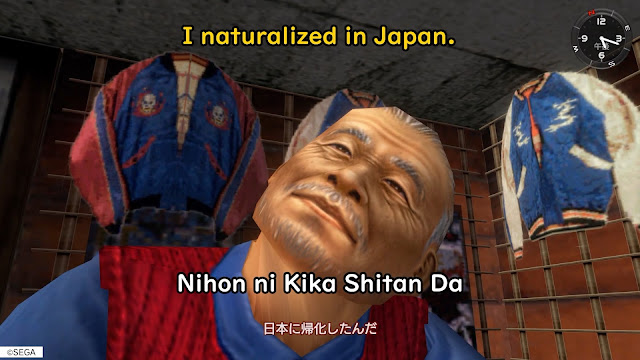
[Japanese] - Shenmue - "Years ago...I was Chinese"


If you've ever played Shenmue before, then you've no doubt ran into this infamous line of dialog.  

The line of dialog in question being:

“Years ago...I was Chinese. Now I’m a Naturalized Japanese. In China, my name was Su Jian Ren.”


Sounds odd, right?

Now here is the original Japanese as presented in game:

--------------------

昔、中国人だったからだよ。日本に帰化したんだ。中国にいたときの名は....

Mukashi, Chugoku Jin Datta Kara Da Yo, Nihon Ni Kika Shitan Da. Chugoku Ni Ita Toki No Na Wa….


“Because long ago, I was Chinese. I naturalized in Japan. In China, my name was Su Jian Ren.”


Still sounds odd, doesn't it?

One of the major issues with Shenmue's original translation is that they translated everything so directly from Japanese to English. As such, it highlights the, at times, incompatibilities between the languages.

The line in the original translation is very much the same as what is said in Japanese. That’s fine with things like honorifics, but elsewhere it is awkward and stilted.

Alternatively, they could have translated it more like this:

“Years ago, when I grew up in China, my name was Su Jian Ren. I changed it when I naturalized.”


However, the concept of Naturalization is still lost in translation here. To keep it simple, Japanese naturalization typically requires a foreigner taking a Japanese name. For example, a number of Rikishi (Sumo Wrestlers) have done this. Most notably Akebano Taro (born Chad Rowan.) This is why Itoi-san mentions his original Chinese name as Su Jian Ren. Only this detail is ultimately lost for those unknowing of the cultural differences.

Akebano Taro on the left (born Chad Rowan)


Therefore Itoi-san has long since taken a Japanese name and now just considers himself a natural Japanese citizen. But alas, this cultural detail is lost in translation and therefore the line of dialog just comes across as stilted.

While Shenmue does stay very true to the Japanese script, it also unfortunately highlights the lost subtle detail going between language and culture.


-Daniel M


Tuesday, November 23, 2021

[Feature] - My Top 5 Dreamcast Games


When I was a child, I grew up with a massive love of everything SEGA. I was as far from the Nintendo kids as one could get. SEGA was my number one guy! The first console I remember in our household was the original SEGA Master System. You know? The big bulky one that came complete with an E-Card Slot that we never once used. My sister and I would play the hell out of that thing. Our three go-to games being Wonder Boy, Sonic the Hedgehog (the much slower Master System port) and Alex Kidd.

Time moved on and I eventually graduated to the Mega Drive. I got to say, I loved the hell out of that console as a kid. I spent countless hours with the likes of NBA Jam, Mortal Kombat II, Sonic The Hedgehog, Street Fighter II among others.

I actually skipped out on their next console, the SEGA Saturn. As much as I wanted a SEGA Saturn, my parents saw the writing on the wall as games were being cleared out on discount tables and opted for the more secure Sony PlayStation. I loved having a PlayStation but deep down, my heart remained with SEGA.

Cut forward to the year 2000 and the SEGA Dreamcast. The Dreamcast marks a special event in my gaming life as it was the first console I bought with my own money. While its lifespan was ultimately very short lived, I still had an absolute blast with that console. So much so that it remained hooked into my TV long after it had officially died in the marketplace.

The Dreamcast has a very special place in my heart and remains a console that I still play regularly to this day. So with all that said, and because I had nothing else better to write about today, let’s take a trip down memory lane as I count down my top 5 Dreamcast games of all time.


5.) Crazy Taxi

Who would have thought that the simple hook of being a Taxi Driver could hold so much appeal in a score attack arcade game? Crazy Taxi is essentially the ultimate escort game. The goal is simple. You have ‘X’ amount of time. You drive around a mock recreation of San Francisco picking up passengers and delivering them to their destination. The faster you get them there, the more time gets added to your clock. Drive with reckless abandon and you earn more money adding to your total score. Rinse and repeat until your time eventually runs out. It’s that simple score attack hook that ultimately makes this game so damn good.

Crazy Taxi’s gameplay focuses on risk and reward mechanics. It’s all about stringing together drifts and near-misses with oncoming traffic to build your combo meter which results in better pay offs from your customers. Drive with reckless abandon and they will reward you...just so long as you don’t crash into anything.

I think it’s clear that Crazy Taxi went on to influence a number of Arcade Racers going forward, most notably Burnout. Burnout shares a similar sense of speed and focuses on rewarding near-misses with oncoming traffic the same way Crazy Taxi does. Also, I have to mention the soundtrack provided by The Offspring and Bad Religion. The soundtrack screams pure 90s punk and further adds to the reckless irreverent charm that Crazy Taxi has about itself. Driving down the hills of San Francisco with The Offspring’s ‘All I Want’ blaring from your car radio makes for a memorable experience indeed.

The simple score attack hook of Crazy Taxi is ultimately what makes it so incredibly endearing. Like all the best games, it’s incredibly simple to pick up but difficult to truly master. That and its infectiously cherry mood makes for a great pick me up experience on those days when I find myself down in the dumps.


----------------

4.) Skies of Arcadia

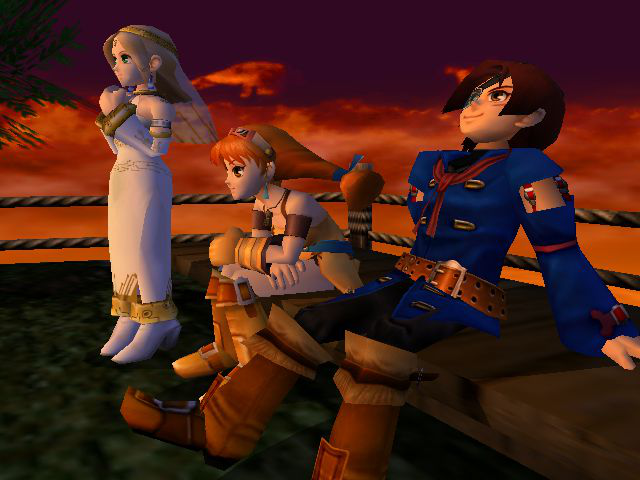
Skies of Arcadia is a wonderful full fledged 3D RPG that takes many of its cues from early 3D Final Fantasy and Dragon Quest games. It’s a turn based adventure that takes us to the skies in flying airships. The overmap is set into six different civilizations coexisting on floating continents orbited by six moons of different colors. You play as Vyse, a headstrong and optimistic natural born leader, who is resisting the empire alongside his best friend Aika. After rescuing Fina, who is one of the survivors of an ancient civilization, they go on a journey to find the powerful Moon Crystals before the empire.

Okay so the story is nothing new if you’ve played countless RPGs, but the setting is really what makes Skies of Arcadia. It’s Sky Pirates fighting in mid air on hovering ships, how can one not love that setting? But it’s really the vast array of interesting characters that help make up for the story’s more generic offerings. That and the turn based combat is really enjoyable. While it never really breaks new ground in terms of the RPG genre, it is still very much a highly enjoyable RPG and one that I sank hours of my life into as a kid. No regrets whatsoever. The soundtrack is great, the expansive world is a blast to explore, and the combat is very satisfying. All of this makes for one of the best RPGs on the Dreamcast.

----------------


3.) Jet Set Radio

Jet Set Radio is a perfect example of SEGA at its peak in terms of creativity. The best way to describe Jet Set Radio is that of a Skating/Graffiti Platformer. The aim of the game is simple enough. You ride around on turbo charged inline skates through various locations in Japan and America tagging walls with spray cans that you collect. You can string all of this together by grinding and wall-riding around the various maps to score-attack. Although the more you tag, the more attention you’ll gain from local authorities as they chase you down and try to catch you.

Much like Crazy Taxi, Jet Set Radio has a very punk attitude about itself. It’s completely anti-authoritarian to the core as it revels in the joy of youth culture. Jet Set Radio is a perfect reflection of the time it came from as the 90s were a time of anti-establishment and rebellion. The soundtrack underneath it is absolutely phenomenal and plays a huge part in its lasting appeal. Its soundtrack bursts to life with a variety of genres including hip-hop, J-pop, electronic dance, rock, acid jazz and a little funk to boot.

Not to mention the visual style of the game as it was one of the first games to really highlight the use of Cell Shading. The game is incredibly bright, colorful and welcoming as its use of heavy ink lines make it look like a cartoon in game form. It was pretty mind blowing for its time having never seen the Cell-Shaded effect before.

I’ll be honest, the first time I played Jet Set Radio, I didn’t like it. For you see, I came to Jet Set from Tony Hawk Pro Skater 2 and was so incredibly accustomed to the way that Tony Hawk played that I made the mistake of trying to play Jet Set as if it were a Tony Hawk clone. My thought was rational to me at the time. Both were skating games. There were already a glutton of Tony Hawk clones so I honestly thought Jet Set was just another Tony Hawk clone. Thus, I didn’t like it the first time I played it as I felt it was way too floaty and didn’t control well.

Then I played it some more and actually got used to the short/long jump mechanics. That was when I began to realize that Jet Set Radio wasn’t a Tony Hawk clone. Rather it was a platformer in the guise of an extreme sports game. Yes, the jumps are floaty but once mastered, I began to realize the appeal of the game is having full control mid-air to line up your next grind as opposed to Tony Hawk’s more magnetized grind approach. That was when I started to fall in love with it. It’s not perfect; the lack of camera controls leave a lot to be desired. But it is a game that rewards mastering and once you fully get the hang of it then it’s a pure blast to play from beginning to end chasing those Jet Rankings.


----------------

2.) Soul Calibur

Soul Calibur is easily one of the greatest fighting games of all time. Launched with the Dreamcast in 1999, it quickly became the killer title for the Dreamcast. Not only a graphical showpiece as to what the new console could do but it also played incredibly well and was packed with single player content to keep you coming back for more. It’s one of those rare cases where it actually looks better on the Dreamcast than it did in its original arcade form. And to think, it was ported by a relatively small internal team at Namco in a very short time period.

A sequel to the weapons based fighter named Soul Edge, Soul Calibur is a marked improvement over its predecessor on every level. It was the first game in the series to introduce the Eight Way Run system, which allowed for full 3D movement whereas most 3D fighters were usually limited to movement along the third axis. This allowed for a full sense of freedom in movement opening up greater strategy for the player.

But the real appeal of the Dreamcast version for me was its fantastic quest mode. Much like Mortal Kombat’s krypt, it was a time sink of various random missions for the player to complete. In doing so, it rewards them points to unlock various goodies such as concept art and other features. I spent hours of my life in that quest mode trying to unlock everything I could. With its combination of addictive quest mode and tight rewarding fighting mechanics, the game is just a true blast all around and is easily one of the greatest fighting games ever made.


----------------


1.) Shenmue I and II


Of course! I mean how could Yu Suzuki’s grand-opus not be at the top of this list for me?

It’s hard for me to separate these two games as they do feel like one cohesive package. Shenmue 1 and 2 highlights everything that made the Dreamcast special. It was a time where SEGA was literally throwing everything at the walls and seeing what sticks. As a company, they weren’t afraid to take massive creative risks. Some could argue that Shenmue is the greatest risk the company ever took.

But unfortunately, it was perhaps just too grand a vision to ever really pay out. Rumored to have cost $70 million dollars to develop (although Yu Suzuki has said it was realistically around $40 million), Shenmue was AAA before AAA existed. It was a massive undertaking for a vision unlike any other. It was in many ways one of the pioneers of the open-world genre. Not the first, but definitely the one that took it to another level. And man, am I thankful for what they gave us.

Starting life as a Virtua Fighter RPG where you would play as Akira on his quest to become the greatest fighter that ever lived, Shenmue eventually took on a life of its own as it aimed to tell a epic multi-parted Kung Fu Revenge story by way of a full blown Life Simulator. At its core, the Virtua Fighter roots are still there as it employs the same fighting engine. Otherwise it became something very different. It’s a full blown evolution of the classic Adventure game that weaves elements of a Detective, Adventure and Action game all into one package.


What always grabbed me about Shenmue was the journey itself. It takes you on a full blown journey from your quiet hometown of Yokosuka through China as Ryo Hazuki. An aspiring young martial artist with much to learn before he can even think of facing his arch nemesis, Lan Di. It’s the little details such as the vital life lessons that makes these two games shine. I’ll never forget traveling to China and learning about the Four Wude. Four simple life principles that you could easily apply and live by in real life. While some of its gameplay may be laughed at by the mainstream, I believe there’s a real ambition to its storytelling that I greatly appreciate. It wants you to live the life of a martial artist. It really wants you to live and learn as Ryo does.

For instance, one of its more mundane gameplay moments is simply a stretch of days where you are forced to carry books out into a yard to air them out. While it’s easy to laugh at this as being a boring or frustrating quest that hinders you from the action, I actually think it’s a slice of narrative genius as it is trying to impart a vital life lesson of patience and discipline upon the player and Ryo. Much the same as a real martial artist would be taught. It’s boldly ambitious storytelling through gameplay and I have always applauded Yu Suzuki and his team for the brass balls they had in just going for it.

Shenmue 1 and 2 are very near and dear to me. For those of us who love it, we know why we love it. We love it because it really encourages us to live the life of Ryo Hazuki. We love it because it is more about the journey than the destination. We love it for its world building. We love it for its atmosphere. We love it because it feels lived in. It’s a game that you just have to soak in and let it simply carry you along at its own pace. Don’t rush it! Just take your time with it and embrace it for everything it is. These two games remain incredibly dear to me. And they always will. Not only are they the culmination of everything Yu Suzuki has done, they are also the embodiment of everything that I loved about SEGA from that era.


------------------------------------

So that’s my list and I’m sticking by it. But what do you say? What were your favorite Dreamcast games? Why not let us know below?

-Daniel M


Friday, November 19, 2021

[Review] - Last Night In Soho


A young, pretty and naive country girl heads to the big city with aspirations of becoming the overnight success story she always dreamed of. Only to be confronted by a barrage of perverted predators looking to feed on hot young flesh in return. Tell me if you haven't heard that story before? It’s an age old riff that we usually see play out under the neon-lights of a Hollywood backdrop. However, ‘Last Night In Soho’ transports this age-old story to the swingin’ psychedelic 60’s Soho in London.

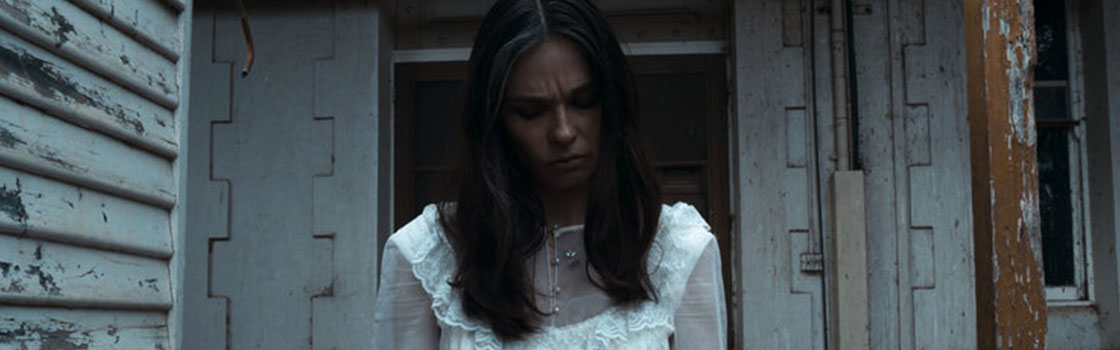
Eloise (Thomasin McKenzie) is an aspiring young fashion designer who moves to Soho as she enters University for her first semester. Having grown up under the loving eye of her grandmother, she has developed a deep love for 60s Brit-Pop culture. However, this makes her stick out like a sore thumb amongst her more trendy dorm-mates leaving her as a target of ridicule. Seeking solace away from her catty roommates, she finds a cheap apartment for rent under the watchful eye of an edlerly landlord (Diana Rigg).

As Eloise’s head hits the pillow, she finds herself dreaming of Soho in the 60s. She dreams of a woman named Sandie (Anya Taylor-Joy); a strikingly beautiful doe-eyed blonde and also an aspiring singer. Sandie finds herself being charmed by a debonair named Jack (Matt Smith). It all seems too good to be true and with good reason as we quickly discover that Jack is not all he seems.


Eloise’s dreams then become nightmares as she watches Sandie descend into the sordid world of prostitution at the hands of Jack and his buddies. Meanwhile, Eloise’s own life turns to hell as the ghosts of the past seemingly cross over from dream-world into reality as they haunt her day-to-day life.

The 60’s is an era that certainly has an ever-lasting appeal. 60’s fashion comes in and out of style regularly amongst hipsters. Bands like Oasis still riff on The Beatles to this day. It was a time of sexual liberation and changing social attitudes. A time of emerging rock-and-roll. But it was also a time that had its own fair share of seediness boiling beneath the surface. Not unlike the world we live in today if you consider the likes of the ‘Me-Too’ movement. As times change, some things remain the same and that’s ultimately what is revealed at the heart of this dark parallel story.

Right from the outset, Thomasin McKenzie does well to portray Eloise as an old-soul stuck in a time period she doesn’t fit into. She lives in her own bubble, dancing around her room to Brit-Pop tunes. She has her own unique brand of oddball fashion as she is first introduced wearing a dress made from old newspapers. It’s all very clearly 60’s inspired. All of which makes her the perfect fish out of water upon entering the big smoke.

As she continuously enters the dream world of Sandie, she becomes more and more consumed by the glamour of nostalgia. She becomes more and more enraptured by the seemingly glamorous life of Sandie. So much so that she goes on to try and recreate Sandie’s physical appearance in a vain attempt to embody her.


One of the more striking visual highlights of the film is when Eloise first steps back into the past and finds herself bombarded by the bright garish lights of a cinema-marquee promoting ‘Sean Connery in Thunderball.’ Another sequence of note is an incredible dance number where the perspectives of Sandie and Eloise change constantly mid dance. It's very well executed as a whole. Alongside the gorgeous cinematography by Chung Hoon-Choo is a dazzling 60’s soundtrack to help build the mood. It really goes out of its way to capture the glamour of its time period.

But it also highlights the stark contrast between 60s Soho and the more dingy and worn-down present day Soho. For not only are the ghosts of the past haunting Eloise, they’re also still haunting the city landscape in general. It evokes much the same love-note feeling as Tarantino’s ‘Once Upon A Time In Hollywood’ as it transports you back in time perfectly recreating an idealistic version of former ‘Soho’.

Being a Horror film though, it doesn’t take long for the glam to be stripped away exposing the real horrors lurking beneath. It’s here where Wright really excels. While this technically isn’t his first foray into the horror genre, it is most certainly a more straight laced horror film than anything he has made before. ‘Soho’ clearly takes its influences from the Argento school of Horror. Obviously, the Argento comparisons can’t help but be made given the visual flair ‘Soho’ has about it. Thankfully though, it still manages to find its own voice along the way.


As the time periods merge, the story further twists and turns. If there is maybe one critique to be had, it’s that it does get a little too familiar in the back-end and doesn’t entirely break new mould. But as a coming-of-age story meets psychedelic horror piece, it does pay off well enough in the end.

It doesn’t always make complete sense in the logic department. Though being a film of such high concept means it can get away with that from time to time. After all, this is a film that is more concerned about the theme than it is a cohesive logical narrative. In that department, the theme rings loud and clear. Even if that theme is maybe a little played out at times. Still, under the confident hand of Edgar Wright and company, ‘Soho’ makes for a most effective and stylish piece of psychedelic horror-cinema all around.


-Daniel M


Monday, November 15, 2021

[Feature] - A Look Back At Little Star by John Ajvide Lindqvist


For the past few years now, John Ajvide Lindqvist has become one of my favorite horror authors. The man made his name a few years back with his most well known work, Let the Right One In. A classic story of a bullied 12 year old boy befriending a vampire. The novel became so quickly beloved that it earned two feature length adaptations of both Swedish and American origin. Much has already been written about Let the Right One In. Hell, I've even written about it here on this very blog. However, not much has been written about his follow up novels. To date, I’ve read almost everything that has been translated into English.

But there is one novel of his in particular that continues to stand out in my mind. That being his 2010 novel, Little Star. A brutal and, at times, darkly funny satire aimed at the Teen Idol sensation. Little Star is an examination of what can go wrong when idol worship is taken to its extremes. It just might also be the best work he has written thus far. Yes, I’d even put it above Let the Right One In.

Little Star tells the story of two teenage girls, Theres and Teresa. Theres is indeed a very peculiar young woman. As a baby, she was left for dead in a plastic bag out in the middle of a Swedish mushroom field. However she is discovered by a man named Lennart who just so happened to be out picking mushrooms in the field. Lennart notices the baby in the bag and breathes life into her only to discover something shocking.

As the baby cries out, he notices a single pitch perfect note within her cry. Being one part of a former one hit wonder pop-duo, Lennart instantly notices the pitch-perfect notes and decides to take the baby back home to his wife. His wife who just so happens to be the other half of that aforementioned one-hit wonder pop-duo.

Back at home, Lennart decides he will keep the baby down in the dark cellar. He does this as a means of keeping her pure and clean from the outside world for he plans to harness her raw musical talent. His wife Leila is far from pleased with this but has long since resigned to her husband's domineering ways and doesn’t dare argue. As time goes on, the baby girl grows up with no real knowledge of the outside world to speak. Two things are for certain though, not only does she develop into a strikingly beautiful young girl, but she also develops the singing voice of an angel.

Fan Art belongs to scarletgothica.com

To keep her from wandering outside and arousing suspicion or curiosity, Lennart makes up a story that there are big people and there are little people. The big people want to eat the little people. If she wants to stay safe then she needs to stay hidden in the cellar. Naturally, this warps her mind leaving her in a constant state of paranoia. After this, she begins to clutch to an electric drill as she sleeps at night for fear of the so-called big people.

As Theres grows older, her only real contact with the outside world is through Leila and Lennart’s middle aged son, Jerry. Jerry has a number of mental issues himself based on his own tortured upbringing at the hands of school bullies. Realizing her for being as much an outsider as he is, he takes an affectionate liking to the girl.

Naturally things go horribly wrong as Lennart’s plan backfires on him. Theres eventually snaps and brutally kills Leila and Lennart with her trusty electric drill. Jerry comes to pay his parents a visit one day only to discover his parents dead on the ground. He quickly decides to take Theres out of the house and back to his apartment in order to protect her.

Fanart Source HangingRabbit

Meanwhile, in a nearby working-class suburb, we meet the other girl. We learn about Teresa from birth up until she enters those awkward teenage years. Her mother doesn’t quite understand her while her father doesn’t have much time for her thanks to a new promotion at work.

As a child, she had difficulty fitting in with the other kids. She does eventually make one friend. A boy named Johannes who quickly grows to adore her like a little puppy dog. For a while, the two become inseparable. It can be said that while he adores her, she still kind of keeps him at arm's reach based on her own peculiarities. But as the two enter puberty, their friendship begins to fracture as Johannes starts to gain the attention of the new pretty girl in school. Meanwhile, Teresa goes the other way as she gains weight, develops terrible acne and becomes entirely self-loathing.

Heartbroken and alone, Teresa begins to withdraw into herself. Her only outlet for her pent up frustration being through the internet as she begins to master the art of trolling under anonymous accounts. She also shows a flair for writing poetry as she spends her days writing on a site where users can submit amatuer poetry. It’s here where she first captures the attention of Theres. Theres encourages her to keep writing her poetry and from here the two quickly strike up a friendship. Leading to the makings of a very dangerous and destructive partnership.

The thing that fascinates me most about Little Star is that it is the one book of John’s that actually deviates from his usual formula. The usual formula of a Lindqvist book is that of the ordinary coming into contact with the other and watching how it plays out. Little Star doesn’t strictly adhere to this formula and instead tells the story of what happens when the other meets the other. 

Neither of the girls are supernatural beings. Instead, they are clearly two very mentally disturbed girls who eventually coax the worst out of each other. Two very important themes emerge from this parallel story. One being the argument of nature versus nurture. And the other being the dangers of idol worship.

One of the major questions asked in the novel is what makes a psychopath? Theres is very much a one dimensional character. She doesn’t really kill out of malice rather she kills out of both what she perceives as self-defense and curiosity as to what is inside the head of another person. At a young age, Theres grows obsessed with a portable CD player gifted to her by Lennart and asks him as to where the music comes from. Lennart tells her that the music comes from inside people's heads for lack of a better answer. This leads to Theres dismantling her one prized possession for no other reason than to find the music within. As she grows older, she is constantly complimented for the amazing power of her singing voice. Lennart and Leila express nothing but love for that voice of hers.

Therefore when she kills Lennart and Leila, it’s not really out of malice, rather she opens their heads to try and find the quality of ‘love’ inside of them. Other than this, she also has an intense mistrust of adults in general thanks to the lie fed to her by her surrogate father. Jerry tries to correct this later on but that deep seeded suspicion of the big people is something she will most likely cling onto for the rest of her days. In many ways you could argue she is the product of nurture as her actions are purely based upon her sheltered upbringing. She knows no better than what she has been taught.

On the other hand, Teresa had a very painstakingly normal upbringing. While misunderstood by her parents, they are still very loving, attentive and trying their best with her. Unlike Theres, she grew up with an understanding of right and wrong. She has a full understanding as to how the world works. And yet, there is still something not quite right about Teresa.

She doesn’t show outward emotion and is very obsessive about certain things. There are hints here that she is somewhere on the autistic spectrum as she is painstakingly logical. For instance, as a little girl, she doesn’t understand why the other kids would want to play make believe as she is very logical and to the point. On that point, both Theres and Teresa share this hint of autism as they both have their own traits. For Theres, one of her traits being she does not like to be touched. Eventually when Teresa meets Theres, she becomes almost entirely possessive over her as their friendship grows. Little by little, Teresa’s true nature is revealed as we watch her moral decline into becoming a full blown psychopath.


The pair then become an internet sensation as Theres records a song with lyrics written by Teresa called Fly. The song quickly becomes an overnight sensation on Youtube. As is described in the book, Theres singing voice has a certain hypnotic quality about it. At first, I believed this to be a hint of the supernatural as is typically the case with all of John’s previous works. But on further reading I don’t believe this to be the case.

Rather the song and it's awkward lyrics become an anthem for the equally lost and confused. Supernatural power is replaced by the simple strangeness of celebrity status and how all it takes to speak to the lost is to play on their deep seated insecurities. Theres has a wonderful voice that can draw you in, but it’s just as much Teresa’s words that hold an equal amount of power. Further playing up that singer-songwriter dynamic between the two.

So what motivates them exactly? Why is Theres so desperate to have her incredible voice shared? I guess the answer is that she’s still searching for that quality of ‘love’ expressed to her by Lennart and Leila. Her motivations aren’t driven out of anything material, rather they are simply driven by her search for that certain quality inside people's heads. The same motivation could be said of Teresa. That Teresa is ultimately just searching for love and acceptance in which she misguidedly finds through Theres.

When the song blows up in popularity, Teresa becomes so deeply depressed that she is committed to a mental hospital for a brief stay. Her depression comes from the fact that she no longer feels like the song belongs to the both of them anymore as it attracts the attention of more lost young girls. One day, she goes to visit Theres only to find Theres interacting with another girl thus she breaks down completely as she believes that she is no longer important to Theres. This goes back to her very possessive nature over Theres in general. But on a side note, it is also maybe a sly comment on the nature of an artist letting their baby go out into the public. I think the key to this is that neither are searching for fame; rather they are simply searching for ‘love.’ In this moment, Teresa feels that ‘love’ and affection shared between them is being snatched away from her. 

Eventually they find themselves the leaders of a group of outcast teenage girls. Teresa comes to realise that none of these girls pose a threat to her shared bond with Theres and begins to accept this wolf pack of sorts. The one common thread all of these girls have is that they are entirely lost at a delicate time in their life. Some of them were abused. All of them feel overlooked and discarded. They’re deeply insecure and desperately yearn to be noticed. The same insecurity that maybe drives young girls to sexualise themselves in front of web cameras.

As such, they all become hopelessly devoted to their idol as they feel she is the only one they can truly identify with. There is also certainly the factor that Theres seemingly knows exactly what to say to all of these girls almost as if she were a crazed cult leader. She is the one person that understands them the best. Or perhaps the real truth is they simply are what they are and all it takes is a little bit of nurturing to coax it out of them. A little bit of nurturing delivered by a voice that can melt hearts and crush brains while at it.

All of which leads to a gruesome massacre orchestrated by these girls. Lindqvist’s writing captures the awkward and painful teenage years of a teenage girl so wonderfully well that you would almost believe he was one. He truly gets inside these girls' heads and finds out what makes them tick. Jealousy, insecurity, anxiety and the strive for finding love and acceptance remain at the heart of this dark fable.

With Little Star, there exist some parallels to his debut novel. Loneliness remains a key theme through both novels and much like Oskar finds himself attracted to the first person to understand him, so too does Teresa fall for Theres. As too does the search for identity and love come through in both novels. However, unlike Oskar and Eli, where Eli’s blood lust is simply driven by a need to survive, Theres and Teresa’s bloodlust is entirely senseless to everyone bar themselves. Hence their ‘love’ becomes one of a ver perverse and destructive nature to everyone that crosses their path as they become the Alphas’ of their dedicated wolf pack. 

Come the end of the novel, Teresa does try to justify their actions with a final letter that she sends to the media. “You will ask why?” she writes before answering her own question with a simple “BECAUSE! Because we were once nice little girls. We once screamed and wept on cue. We worshiped ourselves when you made us stars. We bought ourselves from you.” Making Little Star an entirely fascinating case study into the minds of two thoroughly disturbed individuals and what happens when they find one another.


-Daniel M