Showing posts with label Gaming. Show all posts

Thursday, January 5, 2023

[Feature] - Shenmue III and the Importance of Routine


As 2023 kicks into gear, I continue my journey of weight loss. For the past five months, I’ve been trying to correct the wrongs in my life by building a better lifestyle for myself. Last year, at my heaviest, I weighed in at 225 kg. Not by any means a number I’m proud of. Come to the end of 2022 and I’ve lost 30kg in total, weighing in at 195 kg as of this date.

While I’m proud of my achievement thus far, I still have a long way to go in my journey, but the biggest thing I took away from last year was the importance of building a routine. As stressed by numerous influential people in my life, routine is key to building a better lifestyle both mentally and physically speaking. Boy, oh boy, did I take that message to heart as I went out of my way to build one.   

When I was a child, I guess I didn’t have much in the way of routine or discipline. Being the youngest in a family of three meant I was left to my own devices a little too much. Not to blame my parents, but routine is something usually stressed from childhood. A child who grows up with a strong sense of routine is more likely to be self-sufficient and capable in adult life than not. 

Take the life of a martial artist, for example. A martial artist lives a life of strict discipline and rigorous routine. The importance of these fundamentals is stressed from childhood, helping the child to grow into a balanced adult. Such is the life that has been stressed upon ‘Shenmue’ protagonist, Ryo Hazuki, from childhood by his mentor and departed father, Iwao.


For those uninitiated, 'Shenmue' is a series of open world action-adventure games created by the legendary Yu Suzuki. On the surface, it tells the story of a young Japanese martial artist seeking revenge for his departed father, but peel back its layers and you'll find something a little more than just that. It's best known as being the pioneer of the open world genre. One thing I appreciate about these games is the life lessons they have always stressed. Its game design has always operated around four basic principles: seek, fight, work and indulge. Four basic principles that could be said to be the fundamentals of life, which is only fitting considering ‘Shenmue’ is part life simulator.

One aspect of the original ‘Shenmue’ and its gameplay loop revolves around daily training. Being an Adventure game whose roots stem from a one-on-one fighting game, it allows you to spend time in the family dojo or the nearby parking lot training your extensive list of moves. While this is not necessarily stressed as a requirement to finish the game, it is something that makes up a part of Ryo’s daily life and helps to further flesh out his role in the world.

On the one hand, the fighting system in the first game is lenient enough to allow even button mashers to finish the game without much difficulty. But for those willing to devote time to learning the fighting system, there is a surprising amount of depth involved, as you can train and evolve your move set just by shadowboxing in the parking lot. Perhaps, at one point, this was meant to be a more significant part of the original game. Maybe somewhere along the line in development, AM2 decided to make the game more readily accessible to a broader audience. Whatever the reason, training played a part in the original game, but it wasn’t until ‘Shenmue III’ that it became a requirement of Ryo’s daily life.

While ‘Shenmue III’ wound up dividing the usually loyal fanbase straight down the middle regarding its debatable lack of story, I’ve always found it to be, in some ways, the most interesting of the franchise thus far. At least in terms of how it further fleshes out some of the gameplay ideas that were in place harking all the way back to the original game.

The main point of division among the fanbase regarding the gameplay changes made in ‘Shenmue III’ was the inclusion of a stamina meter. In previous games, there was no stamina meter. Ryo was free to run until his heart was content. ‘Shenmue III’ incorporates the new function of allowing Ryo to eat, alongside that comes a stamina meter. However, the stamina meter also plays host to your health meter.


Everything of vital importance is tied to this meter. If your meter runs out, you lose the ability to run as the game forces you to walk until you eat something to replenish the meter. Or if you enter an unexpected fight and your meter is half way down, then you are at a disadvantage to your maxed out opponent. The reason for this was to stress the importance of eating. This all ties back to the importance of finding a way to earn money to buy food. Which, in turn, sends the player navigating the various odd jobs and distractions that the game has to offer when not progressing the main plot.

‘Shenmue’ has always stressed the importance of money with regard to general plot progression. In the first two games, you literally can’t progress at specific points of the plot until you’ve earned enough in-game money to do so. What fascinates me about the third game is how YSNet attempted to go even further by making the in-game currency a vital part of everything you do. Earning money is a daily necessity and further feeds back into the game's strong sense of routine.

The other significant addition to ‘Shenmue III’ was the inclusion of strength and defense attributes for Ryo. Moving more into traditional RPG territory, the game stresses the importance of rigorous daily training in order to level up Ryo’s stats. The game level gates your enemies to a higher level. Training becomes a vital necessity if you want to beat your enemies.

While the original game did allow you to level up individual moves, it didn’t necessarily change Ryo’s physical stats. Ryo had no physical stats in the original games. There was no level gating. Instead the game catered to the skill level of the player with an automatic adjusting difficulty scale. While some have argued that the inclusion of these new physical stats was to mask the game’s shortcomings in its weaker battle system (as compared to the ‘Virtua Fighter’ engine of the first two games), I would argue it’s kind of a stroke of genius that helps convey the importance of routine through gameplay.


A typical day in ‘Shenmue III’ for me was spent as such. I would wake up, grab the fruit from the tiny kitchen of Shenhua’s house and have a quick chat with her. I would then leave the house, stroll casually down the path picking wild herbs along the way; then I would stop at the nearby martial arts dojo, where I would spend at least 30 minutes strength training by way of Horse Stance and the One Inch Punch. Afterward, I would go and spar with some of the martial artists of the dojo before bowing out and strolling into town to carry on my day.

That was my daily routine during my entire first playthrough of the game. It never wavered from that. That was every morning spent in Bailu. I would build my stats up every morning without fail. Even now, when revisiting it, I still adhere to this routine.

Harking back to the four WUDE learned in ‘Shenmue II’, it becomes all too clear that it’s a sly means of incorporating the principle of GON (to train every day without neglect) into the actual gameplay loop. Doing so does something that the original game touched upon but never entirely made into a necessity. It slyly stresses upon the player the virtues of routine. Live by the routine and Ryo will grow stronger as a result. That's not exactly a bad lesson as far as life lessons go.

As of now, in my current daily life, my real-life routine is as such. I’ll wake up, apply some skincare, have breakfast, read a couple of pages in whatever book I’m reading, drink at least 2L of water a day and do strength training for 20-25 minutes working with weights or resistance bands. Then I’ll do some work followed by a 7km walk around the neighborhood in the late afternoon. I’ve kept to this since August of last year. In many ways, it’s not unlike the one I fashioned for Ryo.

Due to this, I have developed an appreciation for the benefits of building a routine. It helps clear the mind of all anxieties. It helps to build muscles. And it most certainly helps to lose weight and improve my quality of life. It also gave me a further appreciation for what Yu Suzuki and his team at YSNet were trying to communicate with ‘Shenmue III’ and its gameplay loop. Sure, I could delve into the many shortcomings of the game, but I’d rather focus on what the game did right and what the game was earnestly trying to convey.


‘Shenmue’ has always stressed patience over instant gratification. It’s a game that wants you to earn its riches through exploration and discovery. 'Shenmue III' simply takes that to the next level by further stressing the importance of daily routine through actual gameplay. Much like life, it’s a game that wants you to learn key fundamentals through rigorous discipline and routine.

In many ways, the overarching revenge plot that fuels ‘Shenmue’ has become a bit of an afterthought for me. Don’t get me wrong; I’m still invested in one day receiving closure to this epic saga of revenge. I still want to know how the story plays out like everyone else in the fanbase.

But the natural charm of ‘Shenmue’ lies in the journey underneath. At its heart, these games are less about revenge and more about living a martial artist's life as he grows and develops in technique. Along with that come the many principles of life imparted by the numerous influential people he meets along the way. Be it the necessity of striving to do the right thing, keeping friends close, always being humble or even striving to improve oneself every day by training.

‘Shenmue III’
may be a flawed game in many regards, but for those willing to invest their time, it does an earnest and fantastic job of conveying the fundamental necessities of life through gameplay. Perhaps that's not what everyone is looking for in their escapist medium, but I personally appreciate the lengths it goes in order to express these ideas. 

In an industry that is mostly about instant gratification and mindless thrills, I believe that ‘Shenmue’ deserves a round of applause for at least trying to impart the core values of patience, discipline and routine. It’s a shame it took me 20 years to fully cotton on and apply them to my life, but at least I got there in the end. Also, who said video games couldn't teach you anything important?

- Daniel M

Friday, December 31, 2021

[Feature] - My Top 10 Games of 2021

10.) Virtua Fighter 5: Ultimate Showdown

Sure, the netcode may have left a LOT to be desired, but I was just happy to have a new Virtua Fighter again. Even if it is just Virtua Fighter 5 with a new coat of paint. Not that it’s a bad thing considering Virtua Fighter 5 is one of the greatest fighting games ever created from both a technical and visual level. At least this might finally pave the way for SEGA to finally commit to a Virtua Fighter 6 down the road. One can only hope! But as is? I really enjoyed my time with VF5: Ultimate Showdown. I only have two requests. 1.) Bring it to Steam and 2.) Research Rollback Netcode for future Virtua Fighter titles.


9.) Ratchet and Clank: Rift Apart

Perhaps the best visual showcase on the PlayStation 5 thus far and arguably one of the best reasons to own a PlayStation 5 (if you can even get your hands on one considering limited stock supplies.) Rift Apart doesn’t necessarily deviate from the formula as much as I would have liked. It is still ultimately more of the same Ratchet and Clank. You will run, gun and platform against countless hordes of enemies as you level up your guns. But it’s still just as much fun as it always has been…even if it doesn’t evolve the formula as much as I might have hoped. Graphically speaking, it’s the closest Insomniac games have come to delivering on that promise of Pixar-like CG.

It really is a beautiful looking game in motion as particle effects fly from every direction at a rock solid 60fps. But graphics aside, the true star on display is the power of the SSD as you seamlessly warp from world to world sans load times. It is quite an impressive showcase of just how fast the SSD in that system really is.


8.) Hitman III

Hitman III delivers another set of mini sandboxes to creatively kill your target in a multitude of ways. But damn if it isn’t still just as fun as it was in the previous two installments. One of my favorite missions in the game involved hunting down my targets in a crowded nightclub. It’s one of the best representations of a nightclub I’ve ever seen in a video game as the dance floor is jammed full of bodies writhing together. Not to mention the joys of discovering the multitude of methods at your disposal to kill your target. Want to make it as simple as poisoning their drink? You can do it! Wanna go over-the-top and drop a lighting rig on them? You can do that too! Hitman III feels the most refined of this trilogy and still packs a massive punch in the number of open-ended creative ways it lets you tackle your mission.


7.) Forza Horizon 5

Sometimes you just feel the need to zone out, drive really fast and enjoy the scenery around you. That’s exactly what Forza Horizon offers for me. Forza Horizon 5 sets a new standard for open-world racers thanks to the power of the next-gen hardware and a development team hitting the peak of its craft. Not only is this the best-looking racing game to date, but its varied Mexican landscape is brimming with exciting things to see and do, and the enormous selection of real-world vehicles will please everyone from novices to the most discerning gearheads. Forza Horizon 5 is one of the best video games of 2021 and is escapism at its best.


6.) Super Mario 3D World + Bowsers Fury

I never actually played Super Mario 3D World when it first released on the Wii U. Truth be told, I never had a Wii U long enough to play it. I gave up on the Wii U very early on. Thank Nintendo for the Switch and its multitude of Wii U ports as 3D World is some of the most fun I’ve had playing a Mario game in quite some time. While not the most overly taxing or challenging of Mario games, its level design is still incredibly solid all around. Some of the later levels do pack at least enough punch to satisfy and it's just a beautifully crafted game all around in typical Nintendo fashion. It’s just pure fun in that typical Mario fashion. But the real surprise here is the included Bowsers Fury which is perhaps a prototype for what a true open world Mario game may feel like should it go in that direction.


5.) Persona 5: Strikers

The pseudo sequel to Persona 5…or the closest we will get to a Persona 5-2. Strikers is a direct follow up to Persona 5 but gone is the traditional turn based RPG mechanics and in its place are Muso mechanics. I’ve got to be honest. I’m not really a big fan of Muso games. Most of them are just too repetitive for my liking. There’s only so much fun you can have from mindlessly beating up hordes of brain dead enemies. But my love of all things Persona fuelled me to keep playing and in spite of myself, I ended up having more fun with this then I ever thought I would. It of course helps that it is set in the Persona universe and my love of Persona in general helps a great deal. It’s a nice follow up nonetheless. I enjoyed spending time with these characters on another journey to find justice in a cruel world.


4.) Resident Evil: Village

While Resident Evil VII was a direct return to the survival horror roots of the RE franchise, Village manages to find the fine line between Survival Horror and Action much the same way that Resident Evil 2 did way back on the original PlayStation. It’s a much tighter and leaner game as a whole. Village boasts plenty of fearsome moments, even when you're armed to the teeth. In what feels like no time at all after admiring the reveal of the imposing Gothic castle, you're surrounded by werewolves, left scrapping for survival with a mixture of bullets, red barrels, and sheer dumb luck. Playing it on Hardcore was quite the unnerving experience indeed. But it really is that fine line between action and survival that it manages to straddle that makes this entry stand out as one of the best games in the series thus far.


3.) Shin Megami Tensei V

For those unaware, SMT is basically a much darker version of Pokemon. It’s a turn based RPG that is all about conversing, negotiating and collecting a multitude of demons to use in battle. SMT V is an incredible evolution of the cult-like beloved SMT franchise. It manages to take the kick-you-in-the-balls old school difficulty that the SMT games are known for and shoves it into a pseudo open-world. Gone are the old school dungeons and in its place is a semi open-world for the player to explore. While it doesn’t have the same story depth as its spin-off franchise Persona does, it excels in just about every other way possible. The turn-based combat is tough as nails but rewarding.


2.) Guilty Gear: Strive

Hands down the best fighting game of the year. Especially that netcode. That wonderful use of rollback netcode is exactly what all fighting games should be striving towards in the future. It’s no joke when I say this game has some of the very best netcode in a fighting game I’ve ever seen. Coming from thousands of hours of delay based netcode in Tekken 7, this felt like a god-send.

Every match I’ve had has felt nothing short of responsive. I can’t stress enough just how good this netcode really is. Not that the netcode makes me a better player, I still ultimately suck at fighting games but that wonderful netcode makes up for a lot of shortcomings when learning this game. On top of that, the game is just incredibly fun and rewarding to learn. It’s a hell of a fighting game all around bolstered by some of the best netcode I’ve ever seen in a fighting game. Take note Namco, SEGA and Capcom. This is how you do proper good netcode! Strive towards replicating it in the future, please.


1.) Lost Judgment

It is largely more of the same Yakuza formula…but I’ll be damned if SEGA doesn’t do that formula so damn well. Lost Judgment follows up from where Judgment left off and tells another compelling story of morality and justice. In fact, it might be one of the best stories that Ryu Ga Gotoku Studio has ever crafted.

Yes, all the things you expect from a Yakuza game are still in place. There’s side stories to encounter. There’s mini-games galore littered throughout the world. Hell, you can even ride a skateboard freely around the open world this time. But the real star of Lost Judgment has to be the High School side quests as our hero joins numerous after school clubs at the high school he is infiltrating. Also, the return to beat-em-up combat is greatly welcomed and greatly improved upon from even the last installment of Judgment. The addition of snake style is incredibly well and fun to level up. It may be more of the same, but SEGA continues to refine this formula and do it oh so well.


- Daniel M

Wednesday, November 24, 2021

[Japanese] - Shenmue - "Years ago...I was Chinese"


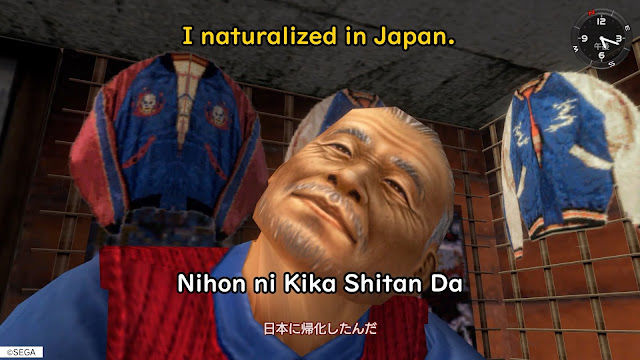
If you've ever played Shenmue before, then you've no doubt ran into this infamous line of dialog.  

The line of dialog in question being:

“Years ago...I was Chinese. Now I’m a Naturalized Japanese. In China, my name was Su Jian Ren.”


Sounds odd, right?

Now here is the original Japanese as presented in game:

--------------------

昔、中国人だったからだよ。日本に帰化したんだ。中国にいたときの名は....

Mukashi, Chugoku Jin Datta Kara Da Yo, Nihon Ni Kika Shitan Da. Chugoku Ni Ita Toki No Na Wa….


“Because long ago, I was Chinese. I naturalized in Japan. In China, my name was Su Jian Ren.”


Still sounds odd, doesn't it?

One of the major issues with Shenmue's original translation is that they translated everything so directly from Japanese to English. As such, it highlights the, at times, incompatibilities between the languages.

The line in the original translation is very much the same as what is said in Japanese. That’s fine with things like honorifics, but elsewhere it is awkward and stilted.

Alternatively, they could have translated it more like this:

“Years ago, when I grew up in China, my name was Su Jian Ren. I changed it when I naturalized.”


However, the concept of Naturalization is still lost in translation here. To keep it simple, Japanese naturalization typically requires a foreigner taking a Japanese name. For example, a number of Rikishi (Sumo Wrestlers) have done this. Most notably Akebano Taro (born Chad Rowan.) This is why Itoi-san mentions his original Chinese name as Su Jian Ren. Only this detail is ultimately lost for those unknowing of the cultural differences.

Akebano Taro on the left (born Chad Rowan)


Therefore Itoi-san has long since taken a Japanese name and now just considers himself a natural Japanese citizen. But alas, this cultural detail is lost in translation and therefore the line of dialog just comes across as stilted.

While Shenmue does stay very true to the Japanese script, it also unfortunately highlights the lost subtle detail going between language and culture.


-Daniel M


Tuesday, November 23, 2021

[Feature] - My Top 5 Dreamcast Games


When I was a child, I grew up with a massive love of everything SEGA. I was as far from the Nintendo kids as one could get. SEGA was my number one guy! The first console I remember in our household was the original SEGA Master System. You know? The big bulky one that came complete with an E-Card Slot that we never once used. My sister and I would play the hell out of that thing. Our three go-to games being Wonder Boy, Sonic the Hedgehog (the much slower Master System port) and Alex Kidd.

Time moved on and I eventually graduated to the Mega Drive. I got to say, I loved the hell out of that console as a kid. I spent countless hours with the likes of NBA Jam, Mortal Kombat II, Sonic The Hedgehog, Street Fighter II among others.

I actually skipped out on their next console, the SEGA Saturn. As much as I wanted a SEGA Saturn, my parents saw the writing on the wall as games were being cleared out on discount tables and opted for the more secure Sony PlayStation. I loved having a PlayStation but deep down, my heart remained with SEGA.

Cut forward to the year 2000 and the SEGA Dreamcast. The Dreamcast marks a special event in my gaming life as it was the first console I bought with my own money. While its lifespan was ultimately very short lived, I still had an absolute blast with that console. So much so that it remained hooked into my TV long after it had officially died in the marketplace.

The Dreamcast has a very special place in my heart and remains a console that I still play regularly to this day. So with all that said, and because I had nothing else better to write about today, let’s take a trip down memory lane as I count down my top 5 Dreamcast games of all time.


5.) Crazy Taxi

Who would have thought that the simple hook of being a Taxi Driver could hold so much appeal in a score attack arcade game? Crazy Taxi is essentially the ultimate escort game. The goal is simple. You have ‘X’ amount of time. You drive around a mock recreation of San Francisco picking up passengers and delivering them to their destination. The faster you get them there, the more time gets added to your clock. Drive with reckless abandon and you earn more money adding to your total score. Rinse and repeat until your time eventually runs out. It’s that simple score attack hook that ultimately makes this game so damn good.

Crazy Taxi’s gameplay focuses on risk and reward mechanics. It’s all about stringing together drifts and near-misses with oncoming traffic to build your combo meter which results in better pay offs from your customers. Drive with reckless abandon and they will reward you...just so long as you don’t crash into anything.

I think it’s clear that Crazy Taxi went on to influence a number of Arcade Racers going forward, most notably Burnout. Burnout shares a similar sense of speed and focuses on rewarding near-misses with oncoming traffic the same way Crazy Taxi does. Also, I have to mention the soundtrack provided by The Offspring and Bad Religion. The soundtrack screams pure 90s punk and further adds to the reckless irreverent charm that Crazy Taxi has about itself. Driving down the hills of San Francisco with The Offspring’s ‘All I Want’ blaring from your car radio makes for a memorable experience indeed.

The simple score attack hook of Crazy Taxi is ultimately what makes it so incredibly endearing. Like all the best games, it’s incredibly simple to pick up but difficult to truly master. That and its infectiously cherry mood makes for a great pick me up experience on those days when I find myself down in the dumps.


----------------

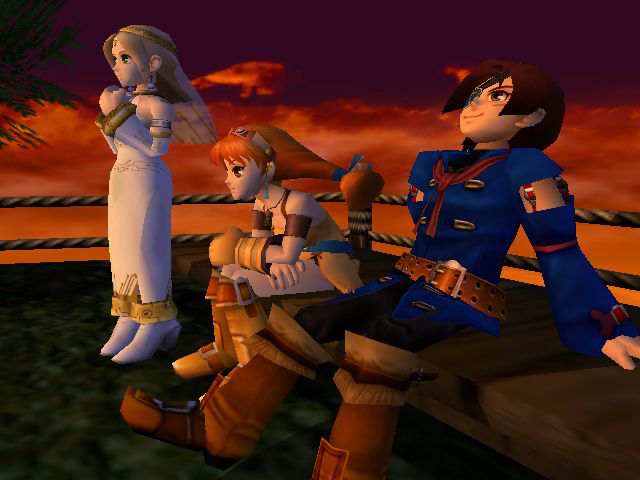
4.) Skies of Arcadia

Skies of Arcadia is a wonderful full fledged 3D RPG that takes many of its cues from early 3D Final Fantasy and Dragon Quest games. It’s a turn based adventure that takes us to the skies in flying airships. The overmap is set into six different civilizations coexisting on floating continents orbited by six moons of different colors. You play as Vyse, a headstrong and optimistic natural born leader, who is resisting the empire alongside his best friend Aika. After rescuing Fina, who is one of the survivors of an ancient civilization, they go on a journey to find the powerful Moon Crystals before the empire.

Okay so the story is nothing new if you’ve played countless RPGs, but the setting is really what makes Skies of Arcadia. It’s Sky Pirates fighting in mid air on hovering ships, how can one not love that setting? But it’s really the vast array of interesting characters that help make up for the story’s more generic offerings. That and the turn based combat is really enjoyable. While it never really breaks new ground in terms of the RPG genre, it is still very much a highly enjoyable RPG and one that I sank hours of my life into as a kid. No regrets whatsoever. The soundtrack is great, the expansive world is a blast to explore, and the combat is very satisfying. All of this makes for one of the best RPGs on the Dreamcast.

----------------


3.) Jet Set Radio

Jet Set Radio is a perfect example of SEGA at its peak in terms of creativity. The best way to describe Jet Set Radio is that of a Skating/Graffiti Platformer. The aim of the game is simple enough. You ride around on turbo charged inline skates through various locations in Japan and America tagging walls with spray cans that you collect. You can string all of this together by grinding and wall-riding around the various maps to score-attack. Although the more you tag, the more attention you’ll gain from local authorities as they chase you down and try to catch you.

Much like Crazy Taxi, Jet Set Radio has a very punk attitude about itself. It’s completely anti-authoritarian to the core as it revels in the joy of youth culture. Jet Set Radio is a perfect reflection of the time it came from as the 90s were a time of anti-establishment and rebellion. The soundtrack underneath it is absolutely phenomenal and plays a huge part in its lasting appeal. Its soundtrack bursts to life with a variety of genres including hip-hop, J-pop, electronic dance, rock, acid jazz and a little funk to boot.

Not to mention the visual style of the game as it was one of the first games to really highlight the use of Cell Shading. The game is incredibly bright, colorful and welcoming as its use of heavy ink lines make it look like a cartoon in game form. It was pretty mind blowing for its time having never seen the Cell-Shaded effect before.

I’ll be honest, the first time I played Jet Set Radio, I didn’t like it. For you see, I came to Jet Set from Tony Hawk Pro Skater 2 and was so incredibly accustomed to the way that Tony Hawk played that I made the mistake of trying to play Jet Set as if it were a Tony Hawk clone. My thought was rational to me at the time. Both were skating games. There were already a glutton of Tony Hawk clones so I honestly thought Jet Set was just another Tony Hawk clone. Thus, I didn’t like it the first time I played it as I felt it was way too floaty and didn’t control well.

Then I played it some more and actually got used to the short/long jump mechanics. That was when I began to realize that Jet Set Radio wasn’t a Tony Hawk clone. Rather it was a platformer in the guise of an extreme sports game. Yes, the jumps are floaty but once mastered, I began to realize the appeal of the game is having full control mid-air to line up your next grind as opposed to Tony Hawk’s more magnetized grind approach. That was when I started to fall in love with it. It’s not perfect; the lack of camera controls leave a lot to be desired. But it is a game that rewards mastering and once you fully get the hang of it then it’s a pure blast to play from beginning to end chasing those Jet Rankings.


----------------

2.) Soul Calibur

Soul Calibur is easily one of the greatest fighting games of all time. Launched with the Dreamcast in 1999, it quickly became the killer title for the Dreamcast. Not only a graphical showpiece as to what the new console could do but it also played incredibly well and was packed with single player content to keep you coming back for more. It’s one of those rare cases where it actually looks better on the Dreamcast than it did in its original arcade form. And to think, it was ported by a relatively small internal team at Namco in a very short time period.

A sequel to the weapons based fighter named Soul Edge, Soul Calibur is a marked improvement over its predecessor on every level. It was the first game in the series to introduce the Eight Way Run system, which allowed for full 3D movement whereas most 3D fighters were usually limited to movement along the third axis. This allowed for a full sense of freedom in movement opening up greater strategy for the player.

But the real appeal of the Dreamcast version for me was its fantastic quest mode. Much like Mortal Kombat’s krypt, it was a time sink of various random missions for the player to complete. In doing so, it rewards them points to unlock various goodies such as concept art and other features. I spent hours of my life in that quest mode trying to unlock everything I could. With its combination of addictive quest mode and tight rewarding fighting mechanics, the game is just a true blast all around and is easily one of the greatest fighting games ever made.


----------------


1.) Shenmue I and II


Of course! I mean how could Yu Suzuki’s grand-opus not be at the top of this list for me?

It’s hard for me to separate these two games as they do feel like one cohesive package. Shenmue 1 and 2 highlights everything that made the Dreamcast special. It was a time where SEGA was literally throwing everything at the walls and seeing what sticks. As a company, they weren’t afraid to take massive creative risks. Some could argue that Shenmue is the greatest risk the company ever took.

But unfortunately, it was perhaps just too grand a vision to ever really pay out. Rumored to have cost $70 million dollars to develop (although Yu Suzuki has said it was realistically around $40 million), Shenmue was AAA before AAA existed. It was a massive undertaking for a vision unlike any other. It was in many ways one of the pioneers of the open-world genre. Not the first, but definitely the one that took it to another level. And man, am I thankful for what they gave us.

Starting life as a Virtua Fighter RPG where you would play as Akira on his quest to become the greatest fighter that ever lived, Shenmue eventually took on a life of its own as it aimed to tell a epic multi-parted Kung Fu Revenge story by way of a full blown Life Simulator. At its core, the Virtua Fighter roots are still there as it employs the same fighting engine. Otherwise it became something very different. It’s a full blown evolution of the classic Adventure game that weaves elements of a Detective, Adventure and Action game all into one package.


What always grabbed me about Shenmue was the journey itself. It takes you on a full blown journey from your quiet hometown of Yokosuka through China as Ryo Hazuki. An aspiring young martial artist with much to learn before he can even think of facing his arch nemesis, Lan Di. It’s the little details such as the vital life lessons that makes these two games shine. I’ll never forget traveling to China and learning about the Four Wude. Four simple life principles that you could easily apply and live by in real life. While some of its gameplay may be laughed at by the mainstream, I believe there’s a real ambition to its storytelling that I greatly appreciate. It wants you to live the life of a martial artist. It really wants you to live and learn as Ryo does.

For instance, one of its more mundane gameplay moments is simply a stretch of days where you are forced to carry books out into a yard to air them out. While it’s easy to laugh at this as being a boring or frustrating quest that hinders you from the action, I actually think it’s a slice of narrative genius as it is trying to impart a vital life lesson of patience and discipline upon the player and Ryo. Much the same as a real martial artist would be taught. It’s boldly ambitious storytelling through gameplay and I have always applauded Yu Suzuki and his team for the brass balls they had in just going for it.

Shenmue 1 and 2 are very near and dear to me. For those of us who love it, we know why we love it. We love it because it really encourages us to live the life of Ryo Hazuki. We love it because it is more about the journey than the destination. We love it for its world building. We love it for its atmosphere. We love it because it feels lived in. It’s a game that you just have to soak in and let it simply carry you along at its own pace. Don’t rush it! Just take your time with it and embrace it for everything it is. These two games remain incredibly dear to me. And they always will. Not only are they the culmination of everything Yu Suzuki has done, they are also the embodiment of everything that I loved about SEGA from that era.


------------------------------------

So that’s my list and I’m sticking by it. But what do you say? What were your favorite Dreamcast games? Why not let us know below?

-Daniel M


Sunday, November 14, 2021

[Feature] Happy 21st Birthday to the Shenmue Dojo


Man, it’s hard to believe it’s been 21 years since I first played Shenmue on my Dreamcast way back when. It’s even harder to believe it’s been at least 19 years since I first heard of the Shenmue Dojo. My first time hearing about the fan site known as the Shenmue Dojo was way back in 2002. I found the Dojo through a simple web search upon looking for info on Shenmue in general. I was hungry for news on Shenmue III given the cliffhanger ending of Shenmue II. Little did I know that it would result in a 14 year wait for it to be officially announced.

The Dojo was one of those sites I would often lurk when looking for new information. Back in my younger days of toying around with web design, I always dreamed about starting a fan page and at that time Shenmue was the number one candidate as I was in love with those games. Then I saw the Dojo and felt a pinch of jealousy. I figured there was no point in making a fan page when these guys had already done a bang up job making one.

I always admired how extensive and knowledgeable the site was regarding Shenmue in general. Although, for reasons of my own, I never actually joined the forum during those formative days. To be honest, I had bad experiences with toxic Anime Communities and really didn’t want my love of Shenmue to be shattered for fear that the community would be just as insufferable. However I did lurk that site for years on end. I would always check in looking for new info while occasionally trawling the forums. That was until 2009, when I went through that period of doubt that I think every Shenmue fan went through at least once in their life. That period of feeling like Shenmue III was an impossibility.

Let’s be real here; SEGA is no longer the SEGA it once was in the 90s. At that point, we were barely getting Yakuza games in the West as once upon a time, we the fans had to beg SEGA to bring them to the West. My oh my, how times have changed in regards to the popularity of Yakuza. But yeah, what chance did we really have of getting Shenmue III if we had to beg SEGA to bring over the latest Yakuza games? So I went through that brief period of doubt. I kind of let my lust for it die as I came to the realization that it probably wouldn’t realistically happen. Although, I would still occasionally lurk the Dojo forums as I couldn’t let that hope die entirely.

Jump forward to 2015 and that amazing Sony E3 conference. That conference has since gone down as legend. The one where all our dreams came true. Being a Fumito Ueda fan, I didn’t think it could get any better than the opening re-emergence of The Last Guardian. Boy, was I wrong though! Because then came the greatest moment of all. The re-emergence of Shenmue with the announcement of the Shenmue III Kickstarter. It was a moment of pure bliss for me and a much needed shot in the arm for the community as a whole. It showed that there was still life to be had in Shenmue and it was a day of celebration for both the die-hards and the skeptics alike.

It was also a day that taught me a valuable life lesson. Don’t give up on your dreams! No matter how impossible they may seem. If Shenmue III could happen against all odds then anything in this life is possible!

And yet, I still didn’t join the forum. I was lurking the forums again, but I didn’t actually sign up until February 2019. Having finally joined the forums; I can honestly say that it has been nothing but a wonderful experience for the last 3 years. I got to join in on the pre-hype for Shenmue III. I’ve translated and written a few pieces for Phantom River Stone since then. But most importantly, I also got to meet and befriend so many amazing people within this community.


Despite the polarized reaction to Shenmue III within the fan base, what surprises me most is that the fire is still burning in all of us. We are now in a much better place than we were before. We have the Anime to look forward to in 2022. We have all this new merchandise that seems to pop up on a daily basis. And there is always the continued hope of getting Shenmue IV. The fire still burns within this franchise and this community continues to push on refusing to let it die.

As such, the Dojo helped re-ignite a passion in me that I thought I had lost a long time ago. In more ways than one. Not only am I back to writing a blog again, but I’m also now running my own Shenmue fan-page on Twitter and Instagram. In the small time that I have been a part of this community it has been very good to me in return and for that I can only thank them.

Much like Shenmue has been teaching me life-lessons without me really noticing, so too has the Dojo taught me something in life. Don’t give up on your dreams! Always reach for the stars and never take no for an answer! So with all of that said, let's salute a Happy Birthday to the Shenmue Dojo.

Congratulations on keeping the fire alive for 21 years!


-Daniel M

Friday, November 5, 2021

[Feature] - Shenmue (or why its open world still matters)


Open world games are a dime a dozen these days. In fact, I would say it’s a genre that is completely over saturated and in need of a rest. Or at the very least in need of a complete overhaul in presentation. But there was a time when the concept of the open world game was entirely new and fresh. That time was December 2000 and it came with the release of Yu Suzuki’s opus magnum Shenmue. A game that some might say pioneered the genre and led the way for what was to come.

At its time of release, it was entirely revolutionary in presenting a living breathing world unlike any other seen in gaming before. Its ambitions were off the charts. This was a game that aimed to present a living breathing world encapsulated in a video game. And to this day, it still remains one of my favorite examples of the open world genre.

Shenmue Chapter 1 takes place in Yokosuka. A virtual recreation of a real life district about 30 to 40 minutes outside of Tokyo. Being a coastal city, Yokosuka plays host to the United States Fleet Activities. Therefore it's a place with a strong American representation as a whole. Having traveled there in real life, I can tell you it's certainly not uncommon to see many Sailors walking about. Within Yokosuka is Dobuita Street and it is here where most of Shenmue Chapter 1 plays out.


Set in 1986, Shenmue pits you in the role of Ryo Hazuki. A 18 year old teenager and aspiring martial artist who witnesses the murder of his father Iwao at the hands of a man known only as Lan Di. With this he swears that he will avenge his fathers death and thus begins his journey.

But where do you begin when you have zero clues as to who this man even is? Why did he kill Ryo's father? And where did he go afterwards? This leads to Ryo questioning the residents of Yokosuka in search of clues. Most of the core gameplay is simply just Ryo walking around town asking the residents of Yokosuka questions. Armed with his trusty notebook, Ryo jots down every detail he can find as the plot progresses.

At its heart, Shenmue is a detective game. It is all about hearsay, conjecture and finding the truth as to what really happened. Time also plays a vital role in Shenmue as the game adheres to an in-game clock. A day in Shenmue lasts about 40 minutes in real time. It’s a full day/night cycle complete with a full blown weather system to boot. As a matter of fact, it allows an option to play with a weather cycle that is completely accurate to real-world weather data from that time period. Quite a neat little attention to detail.

Everything is dependent on time in Shenmue. Meetings are set to certain time periods that the player must adhere to in order to advance the plot. In between, the game will frequently let you off the leash to explore Yokosuka at your own pace while waiting for the next event. Within Yokosuka, you can find all sorts of treats to fill your time as you wait for the next meeting to advance the plot.


What was mind blowing at the time was the level of detail presented in this world. It was a full living breathing city unlike any other seen in gaming at that time. The people of Yokosuka had their own schedules that they lived by. Shopkeepers had their daily routines of opening shop, serving customers and then closing shop at the end of the day before heading home. There were capsule toys to buy from the many Gacha machines.

There were many stores to explore where you could buy items such as move scrolls to build your move list. There was a fully functional arcade where you could play classic SEGA arcade games such as Space Harrier or Hang On to pass the time. You could talk to almost everyone that walked around town and they all had lines of dialog that would change depending on the current event you were pursuing. You could look at and pick up almost every item in the game. You could spend time leveling up your moves as you trained in a random parking lot. Hell, you could even open every door and drawer in your house just simply because you could.

The detail presented in this game was off the charts compared to anything else that was on the market at the time. There was a real sense of place and atmosphere that was unrivaled.What was exciting about Shenmue and what remains impressive about it to me to this day is the way in which it presents its world. In most games, the world usually revolves around the character. Everything is central to what the character is doing in the here and now. Shenmue aims to present the opposite. Instead, it plays up the illusion that Ryo is simply a small part of his world as the world moves on with or without him.

It's a place that actually has a lived in history about it. The people of this town have known Ryo ever since he was a child. The local store keep affectionately refers to Ryo as "Baby Boy Ryo" every time you enter. Old timers and children alike just casually sit in a park going about their daily lives. At night, the drunkards come out and stumble around town as they bar hop. It goes an incredibly long way to build the illusion of a world that feels lived in as it highlights the daily habits of its residency.


There are many side quests and cut scenes in the game that can be entirely missed simply because you weren’t in the right place at the right time. Seeing that the game is set in 1986, there are no cell phones. So for instance, if you stay out wandering town late at night then you will most likely miss a phone call back at home from your love interest Nozomi. Hence you will miss a particular scene that plays out between them. But this isn’t an instance of the game punishing you. Rather it’s an instance of the game giving you freedom to play as you see fit without giving you a roadmap or checklist to adhere to (as most modern open world games do these days.)

That’s the remarkable thing about Shenmue though. It’s a game that really wants you to explore its world at your own pace and leisure. Depending on how you play, it will always reward you with something new and unexpected. It’s a game that is not entirely about going from plot beat to plot beat, but rather a game that urges you to soak in its environment and simply live in its world. Other than the missing gaps in the notebook, it gives you no indication as to what you can find or maybe have missed out on. There is no mini map. There are no mission quest markers. Everything is entirely dependent on you exploring the world at your own pace and finding the hidden details buried within. In that sense, it's very organic in a way that most open world games are not.


In too many open world games I never really feel that I’m living the character's life. I remember when Grand Theft Auto 3 was released a mere year later for the PlayStation 2. The size and scope of its open world was awesome for the time. It was a genuinely fun game letting you cause mayhem at your own free will. But even back then, I remember being somewhat less than impressed. While the game was pure unadulterated fun at its core, I couldn’t help but feel that it was nowhere near as revolutionary as the game I played a mere year before it.

Let’s be honest, Grand Theft Auto 3 was quite a muddy game to look at. Yes, the sheer unadulterated mayhem it let you cause in its sandbox was fun as all hell, but the actual world it presented was rather bare bones in terms of attention to detail. NPCs were just meaningless cannon fodder to be killed with ease. Buildings were just empty backdrops with no sign of life. Outside of Telephone Box Side Quests and Hidden Packages, there was no real sense of discovery to be had in GTA III.


While it may sound like I’m ragging on GTA III, please don’t get me wrong. I wholeheartedly love GTA III and still consider it to be one of my favorite games of that generation. But there was no denying that going from the insanely detailed Shenmue to GTA III was maybe slightly underwhelming for me and in some ways felt like a step backwards. Shenmue showed me a glimpse of something beyond anything else I had seen in gaming at that point and it was just a little too difficult for Grand Theft Auto III to compare.

In fact, I remember when Grand Theft Auto IV was finally released on PlayStation 3. I remember reading the reviews at the time and how game journalists were praising IV for presenting a living breathing city where NPCs would do Yoga in the Park. I remember reading these trade reviews and thinking to myself “wow, it took Rockstar an entire generation to catch up to what SEGA was doing way back on the Dreamcast.”

It’s for these reasons that I still find myself going back to Shenmue and find myself still marveling at its impressive technical scope. Sure, we take all of these things for granted in open world games nowadays. Day/Night cycles, full weather cycles, in-game mini games among others are commonplace in most open world games nowadays.


But going back to Shenmue on the Dreamcast is a reminder as to just how far ahead of the curb Yu Suzuki and his team really were. They were doing all of these things long before the competition and they did it at a level of minute detail that took the competition many years to catch up. In many ways, Shenmue still remains one of my favorite open world games simply because of how it presents its world as a place that urges self discovery and full immersion without guides or checklists. Something that I feel most open world games could still learn a thing or two from.

-Daniel M