Showing posts with label Sega. Show all posts

Thursday, January 5, 2023

[Feature] - Shenmue III and the Importance of Routine


As 2023 kicks into gear, I continue my journey of weight loss. For the past five months, I’ve been trying to correct the wrongs in my life by building a better lifestyle for myself. Last year, at my heaviest, I weighed in at 225 kg. Not by any means a number I’m proud of. Come to the end of 2022 and I’ve lost 30kg in total, weighing in at 195 kg as of this date.

While I’m proud of my achievement thus far, I still have a long way to go in my journey, but the biggest thing I took away from last year was the importance of building a routine. As stressed by numerous influential people in my life, routine is key to building a better lifestyle both mentally and physically speaking. Boy, oh boy, did I take that message to heart as I went out of my way to build one.   

When I was a child, I guess I didn’t have much in the way of routine or discipline. Being the youngest in a family of three meant I was left to my own devices a little too much. Not to blame my parents, but routine is something usually stressed from childhood. A child who grows up with a strong sense of routine is more likely to be self-sufficient and capable in adult life than not. 

Take the life of a martial artist, for example. A martial artist lives a life of strict discipline and rigorous routine. The importance of these fundamentals is stressed from childhood, helping the child to grow into a balanced adult. Such is the life that has been stressed upon ‘Shenmue’ protagonist, Ryo Hazuki, from childhood by his mentor and departed father, Iwao.


For those uninitiated, 'Shenmue' is a series of open world action-adventure games created by the legendary Yu Suzuki. On the surface, it tells the story of a young Japanese martial artist seeking revenge for his departed father, but peel back its layers and you'll find something a little more than just that. It's best known as being the pioneer of the open world genre. One thing I appreciate about these games is the life lessons they have always stressed. Its game design has always operated around four basic principles: seek, fight, work and indulge. Four basic principles that could be said to be the fundamentals of life, which is only fitting considering ‘Shenmue’ is part life simulator.

One aspect of the original ‘Shenmue’ and its gameplay loop revolves around daily training. Being an Adventure game whose roots stem from a one-on-one fighting game, it allows you to spend time in the family dojo or the nearby parking lot training your extensive list of moves. While this is not necessarily stressed as a requirement to finish the game, it is something that makes up a part of Ryo’s daily life and helps to further flesh out his role in the world.

On the one hand, the fighting system in the first game is lenient enough to allow even button mashers to finish the game without much difficulty. But for those willing to devote time to learning the fighting system, there is a surprising amount of depth involved, as you can train and evolve your move set just by shadowboxing in the parking lot. Perhaps, at one point, this was meant to be a more significant part of the original game. Maybe somewhere along the line in development, AM2 decided to make the game more readily accessible to a broader audience. Whatever the reason, training played a part in the original game, but it wasn’t until ‘Shenmue III’ that it became a requirement of Ryo’s daily life.

While ‘Shenmue III’ wound up dividing the usually loyal fanbase straight down the middle regarding its debatable lack of story, I’ve always found it to be, in some ways, the most interesting of the franchise thus far. At least in terms of how it further fleshes out some of the gameplay ideas that were in place harking all the way back to the original game.

The main point of division among the fanbase regarding the gameplay changes made in ‘Shenmue III’ was the inclusion of a stamina meter. In previous games, there was no stamina meter. Ryo was free to run until his heart was content. ‘Shenmue III’ incorporates the new function of allowing Ryo to eat, alongside that comes a stamina meter. However, the stamina meter also plays host to your health meter.


Everything of vital importance is tied to this meter. If your meter runs out, you lose the ability to run as the game forces you to walk until you eat something to replenish the meter. Or if you enter an unexpected fight and your meter is half way down, then you are at a disadvantage to your maxed out opponent. The reason for this was to stress the importance of eating. This all ties back to the importance of finding a way to earn money to buy food. Which, in turn, sends the player navigating the various odd jobs and distractions that the game has to offer when not progressing the main plot.

‘Shenmue’ has always stressed the importance of money with regard to general plot progression. In the first two games, you literally can’t progress at specific points of the plot until you’ve earned enough in-game money to do so. What fascinates me about the third game is how YSNet attempted to go even further by making the in-game currency a vital part of everything you do. Earning money is a daily necessity and further feeds back into the game's strong sense of routine.

The other significant addition to ‘Shenmue III’ was the inclusion of strength and defense attributes for Ryo. Moving more into traditional RPG territory, the game stresses the importance of rigorous daily training in order to level up Ryo’s stats. The game level gates your enemies to a higher level. Training becomes a vital necessity if you want to beat your enemies.

While the original game did allow you to level up individual moves, it didn’t necessarily change Ryo’s physical stats. Ryo had no physical stats in the original games. There was no level gating. Instead the game catered to the skill level of the player with an automatic adjusting difficulty scale. While some have argued that the inclusion of these new physical stats was to mask the game’s shortcomings in its weaker battle system (as compared to the ‘Virtua Fighter’ engine of the first two games), I would argue it’s kind of a stroke of genius that helps convey the importance of routine through gameplay.


A typical day in ‘Shenmue III’ for me was spent as such. I would wake up, grab the fruit from the tiny kitchen of Shenhua’s house and have a quick chat with her. I would then leave the house, stroll casually down the path picking wild herbs along the way; then I would stop at the nearby martial arts dojo, where I would spend at least 30 minutes strength training by way of Horse Stance and the One Inch Punch. Afterward, I would go and spar with some of the martial artists of the dojo before bowing out and strolling into town to carry on my day.

That was my daily routine during my entire first playthrough of the game. It never wavered from that. That was every morning spent in Bailu. I would build my stats up every morning without fail. Even now, when revisiting it, I still adhere to this routine.

Harking back to the four WUDE learned in ‘Shenmue II’, it becomes all too clear that it’s a sly means of incorporating the principle of GON (to train every day without neglect) into the actual gameplay loop. Doing so does something that the original game touched upon but never entirely made into a necessity. It slyly stresses upon the player the virtues of routine. Live by the routine and Ryo will grow stronger as a result. That's not exactly a bad lesson as far as life lessons go.

As of now, in my current daily life, my real-life routine is as such. I’ll wake up, apply some skincare, have breakfast, read a couple of pages in whatever book I’m reading, drink at least 2L of water a day and do strength training for 20-25 minutes working with weights or resistance bands. Then I’ll do some work followed by a 7km walk around the neighborhood in the late afternoon. I’ve kept to this since August of last year. In many ways, it’s not unlike the one I fashioned for Ryo.

Due to this, I have developed an appreciation for the benefits of building a routine. It helps clear the mind of all anxieties. It helps to build muscles. And it most certainly helps to lose weight and improve my quality of life. It also gave me a further appreciation for what Yu Suzuki and his team at YSNet were trying to communicate with ‘Shenmue III’ and its gameplay loop. Sure, I could delve into the many shortcomings of the game, but I’d rather focus on what the game did right and what the game was earnestly trying to convey.


‘Shenmue’ has always stressed patience over instant gratification. It’s a game that wants you to earn its riches through exploration and discovery. 'Shenmue III' simply takes that to the next level by further stressing the importance of daily routine through actual gameplay. Much like life, it’s a game that wants you to learn key fundamentals through rigorous discipline and routine.

In many ways, the overarching revenge plot that fuels ‘Shenmue’ has become a bit of an afterthought for me. Don’t get me wrong; I’m still invested in one day receiving closure to this epic saga of revenge. I still want to know how the story plays out like everyone else in the fanbase.

But the natural charm of ‘Shenmue’ lies in the journey underneath. At its heart, these games are less about revenge and more about living a martial artist's life as he grows and develops in technique. Along with that come the many principles of life imparted by the numerous influential people he meets along the way. Be it the necessity of striving to do the right thing, keeping friends close, always being humble or even striving to improve oneself every day by training.

‘Shenmue III’
may be a flawed game in many regards, but for those willing to invest their time, it does an earnest and fantastic job of conveying the fundamental necessities of life through gameplay. Perhaps that's not what everyone is looking for in their escapist medium, but I personally appreciate the lengths it goes in order to express these ideas. 

In an industry that is mostly about instant gratification and mindless thrills, I believe that ‘Shenmue’ deserves a round of applause for at least trying to impart the core values of patience, discipline and routine. It’s a shame it took me 20 years to fully cotton on and apply them to my life, but at least I got there in the end. Also, who said video games couldn't teach you anything important?

- Daniel M

Tuesday, November 23, 2021

[Feature] - My Top 5 Dreamcast Games


When I was a child, I grew up with a massive love of everything SEGA. I was as far from the Nintendo kids as one could get. SEGA was my number one guy! The first console I remember in our household was the original SEGA Master System. You know? The big bulky one that came complete with an E-Card Slot that we never once used. My sister and I would play the hell out of that thing. Our three go-to games being Wonder Boy, Sonic the Hedgehog (the much slower Master System port) and Alex Kidd.

Time moved on and I eventually graduated to the Mega Drive. I got to say, I loved the hell out of that console as a kid. I spent countless hours with the likes of NBA Jam, Mortal Kombat II, Sonic The Hedgehog, Street Fighter II among others.

I actually skipped out on their next console, the SEGA Saturn. As much as I wanted a SEGA Saturn, my parents saw the writing on the wall as games were being cleared out on discount tables and opted for the more secure Sony PlayStation. I loved having a PlayStation but deep down, my heart remained with SEGA.

Cut forward to the year 2000 and the SEGA Dreamcast. The Dreamcast marks a special event in my gaming life as it was the first console I bought with my own money. While its lifespan was ultimately very short lived, I still had an absolute blast with that console. So much so that it remained hooked into my TV long after it had officially died in the marketplace.

The Dreamcast has a very special place in my heart and remains a console that I still play regularly to this day. So with all that said, and because I had nothing else better to write about today, let’s take a trip down memory lane as I count down my top 5 Dreamcast games of all time.


5.) Crazy Taxi

Who would have thought that the simple hook of being a Taxi Driver could hold so much appeal in a score attack arcade game? Crazy Taxi is essentially the ultimate escort game. The goal is simple. You have ‘X’ amount of time. You drive around a mock recreation of San Francisco picking up passengers and delivering them to their destination. The faster you get them there, the more time gets added to your clock. Drive with reckless abandon and you earn more money adding to your total score. Rinse and repeat until your time eventually runs out. It’s that simple score attack hook that ultimately makes this game so damn good.

Crazy Taxi’s gameplay focuses on risk and reward mechanics. It’s all about stringing together drifts and near-misses with oncoming traffic to build your combo meter which results in better pay offs from your customers. Drive with reckless abandon and they will reward you...just so long as you don’t crash into anything.

I think it’s clear that Crazy Taxi went on to influence a number of Arcade Racers going forward, most notably Burnout. Burnout shares a similar sense of speed and focuses on rewarding near-misses with oncoming traffic the same way Crazy Taxi does. Also, I have to mention the soundtrack provided by The Offspring and Bad Religion. The soundtrack screams pure 90s punk and further adds to the reckless irreverent charm that Crazy Taxi has about itself. Driving down the hills of San Francisco with The Offspring’s ‘All I Want’ blaring from your car radio makes for a memorable experience indeed.

The simple score attack hook of Crazy Taxi is ultimately what makes it so incredibly endearing. Like all the best games, it’s incredibly simple to pick up but difficult to truly master. That and its infectiously cherry mood makes for a great pick me up experience on those days when I find myself down in the dumps.


----------------

4.) Skies of Arcadia

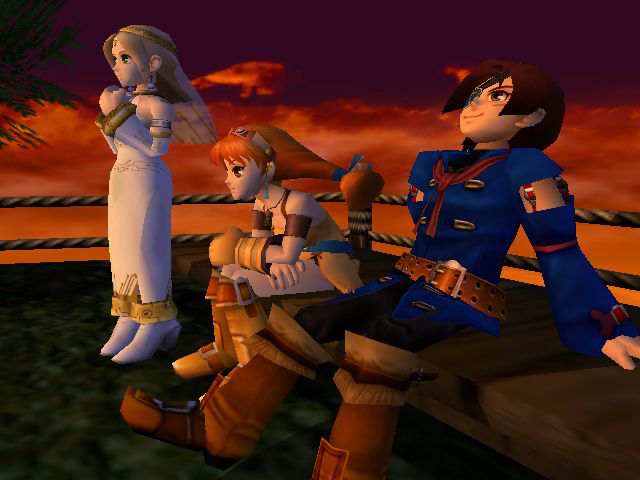
Skies of Arcadia is a wonderful full fledged 3D RPG that takes many of its cues from early 3D Final Fantasy and Dragon Quest games. It’s a turn based adventure that takes us to the skies in flying airships. The overmap is set into six different civilizations coexisting on floating continents orbited by six moons of different colors. You play as Vyse, a headstrong and optimistic natural born leader, who is resisting the empire alongside his best friend Aika. After rescuing Fina, who is one of the survivors of an ancient civilization, they go on a journey to find the powerful Moon Crystals before the empire.

Okay so the story is nothing new if you’ve played countless RPGs, but the setting is really what makes Skies of Arcadia. It’s Sky Pirates fighting in mid air on hovering ships, how can one not love that setting? But it’s really the vast array of interesting characters that help make up for the story’s more generic offerings. That and the turn based combat is really enjoyable. While it never really breaks new ground in terms of the RPG genre, it is still very much a highly enjoyable RPG and one that I sank hours of my life into as a kid. No regrets whatsoever. The soundtrack is great, the expansive world is a blast to explore, and the combat is very satisfying. All of this makes for one of the best RPGs on the Dreamcast.

----------------


3.) Jet Set Radio

Jet Set Radio is a perfect example of SEGA at its peak in terms of creativity. The best way to describe Jet Set Radio is that of a Skating/Graffiti Platformer. The aim of the game is simple enough. You ride around on turbo charged inline skates through various locations in Japan and America tagging walls with spray cans that you collect. You can string all of this together by grinding and wall-riding around the various maps to score-attack. Although the more you tag, the more attention you’ll gain from local authorities as they chase you down and try to catch you.

Much like Crazy Taxi, Jet Set Radio has a very punk attitude about itself. It’s completely anti-authoritarian to the core as it revels in the joy of youth culture. Jet Set Radio is a perfect reflection of the time it came from as the 90s were a time of anti-establishment and rebellion. The soundtrack underneath it is absolutely phenomenal and plays a huge part in its lasting appeal. Its soundtrack bursts to life with a variety of genres including hip-hop, J-pop, electronic dance, rock, acid jazz and a little funk to boot.

Not to mention the visual style of the game as it was one of the first games to really highlight the use of Cell Shading. The game is incredibly bright, colorful and welcoming as its use of heavy ink lines make it look like a cartoon in game form. It was pretty mind blowing for its time having never seen the Cell-Shaded effect before.

I’ll be honest, the first time I played Jet Set Radio, I didn’t like it. For you see, I came to Jet Set from Tony Hawk Pro Skater 2 and was so incredibly accustomed to the way that Tony Hawk played that I made the mistake of trying to play Jet Set as if it were a Tony Hawk clone. My thought was rational to me at the time. Both were skating games. There were already a glutton of Tony Hawk clones so I honestly thought Jet Set was just another Tony Hawk clone. Thus, I didn’t like it the first time I played it as I felt it was way too floaty and didn’t control well.

Then I played it some more and actually got used to the short/long jump mechanics. That was when I began to realize that Jet Set Radio wasn’t a Tony Hawk clone. Rather it was a platformer in the guise of an extreme sports game. Yes, the jumps are floaty but once mastered, I began to realize the appeal of the game is having full control mid-air to line up your next grind as opposed to Tony Hawk’s more magnetized grind approach. That was when I started to fall in love with it. It’s not perfect; the lack of camera controls leave a lot to be desired. But it is a game that rewards mastering and once you fully get the hang of it then it’s a pure blast to play from beginning to end chasing those Jet Rankings.


----------------

2.) Soul Calibur

Soul Calibur is easily one of the greatest fighting games of all time. Launched with the Dreamcast in 1999, it quickly became the killer title for the Dreamcast. Not only a graphical showpiece as to what the new console could do but it also played incredibly well and was packed with single player content to keep you coming back for more. It’s one of those rare cases where it actually looks better on the Dreamcast than it did in its original arcade form. And to think, it was ported by a relatively small internal team at Namco in a very short time period.

A sequel to the weapons based fighter named Soul Edge, Soul Calibur is a marked improvement over its predecessor on every level. It was the first game in the series to introduce the Eight Way Run system, which allowed for full 3D movement whereas most 3D fighters were usually limited to movement along the third axis. This allowed for a full sense of freedom in movement opening up greater strategy for the player.

But the real appeal of the Dreamcast version for me was its fantastic quest mode. Much like Mortal Kombat’s krypt, it was a time sink of various random missions for the player to complete. In doing so, it rewards them points to unlock various goodies such as concept art and other features. I spent hours of my life in that quest mode trying to unlock everything I could. With its combination of addictive quest mode and tight rewarding fighting mechanics, the game is just a true blast all around and is easily one of the greatest fighting games ever made.


----------------


1.) Shenmue I and II


Of course! I mean how could Yu Suzuki’s grand-opus not be at the top of this list for me?

It’s hard for me to separate these two games as they do feel like one cohesive package. Shenmue 1 and 2 highlights everything that made the Dreamcast special. It was a time where SEGA was literally throwing everything at the walls and seeing what sticks. As a company, they weren’t afraid to take massive creative risks. Some could argue that Shenmue is the greatest risk the company ever took.

But unfortunately, it was perhaps just too grand a vision to ever really pay out. Rumored to have cost $70 million dollars to develop (although Yu Suzuki has said it was realistically around $40 million), Shenmue was AAA before AAA existed. It was a massive undertaking for a vision unlike any other. It was in many ways one of the pioneers of the open-world genre. Not the first, but definitely the one that took it to another level. And man, am I thankful for what they gave us.

Starting life as a Virtua Fighter RPG where you would play as Akira on his quest to become the greatest fighter that ever lived, Shenmue eventually took on a life of its own as it aimed to tell a epic multi-parted Kung Fu Revenge story by way of a full blown Life Simulator. At its core, the Virtua Fighter roots are still there as it employs the same fighting engine. Otherwise it became something very different. It’s a full blown evolution of the classic Adventure game that weaves elements of a Detective, Adventure and Action game all into one package.


What always grabbed me about Shenmue was the journey itself. It takes you on a full blown journey from your quiet hometown of Yokosuka through China as Ryo Hazuki. An aspiring young martial artist with much to learn before he can even think of facing his arch nemesis, Lan Di. It’s the little details such as the vital life lessons that makes these two games shine. I’ll never forget traveling to China and learning about the Four Wude. Four simple life principles that you could easily apply and live by in real life. While some of its gameplay may be laughed at by the mainstream, I believe there’s a real ambition to its storytelling that I greatly appreciate. It wants you to live the life of a martial artist. It really wants you to live and learn as Ryo does.

For instance, one of its more mundane gameplay moments is simply a stretch of days where you are forced to carry books out into a yard to air them out. While it’s easy to laugh at this as being a boring or frustrating quest that hinders you from the action, I actually think it’s a slice of narrative genius as it is trying to impart a vital life lesson of patience and discipline upon the player and Ryo. Much the same as a real martial artist would be taught. It’s boldly ambitious storytelling through gameplay and I have always applauded Yu Suzuki and his team for the brass balls they had in just going for it.

Shenmue 1 and 2 are very near and dear to me. For those of us who love it, we know why we love it. We love it because it really encourages us to live the life of Ryo Hazuki. We love it because it is more about the journey than the destination. We love it for its world building. We love it for its atmosphere. We love it because it feels lived in. It’s a game that you just have to soak in and let it simply carry you along at its own pace. Don’t rush it! Just take your time with it and embrace it for everything it is. These two games remain incredibly dear to me. And they always will. Not only are they the culmination of everything Yu Suzuki has done, they are also the embodiment of everything that I loved about SEGA from that era.


------------------------------------

So that’s my list and I’m sticking by it. But what do you say? What were your favorite Dreamcast games? Why not let us know below?

-Daniel M